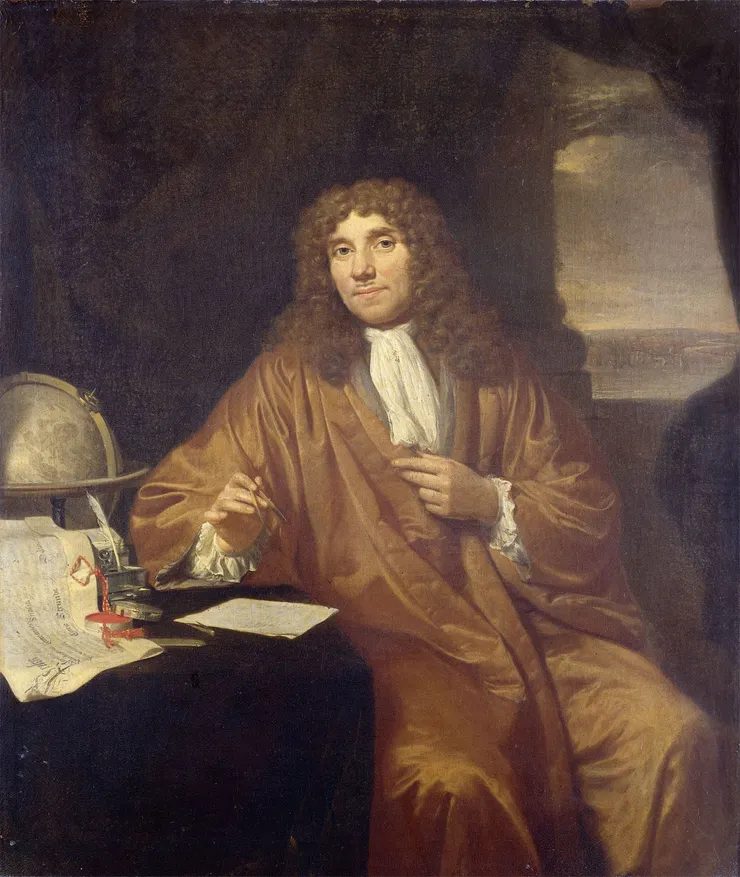
Antonie van Leeuwenhoek changed science not by being a university professor, but by being a guy with a keen eye and a steady hand. Born in Delft, Netherlands, on October 24, 1632, he started life as an apprentice to a draper. He wasn’t studying chemistry or physics. He was learning about fabric. But that trade gave him access to fine materials and perhaps more importantly, the patience to look closely at things.
Later, a civil service position freed up his time. This was the key. He didn’t just look. He built.
He spent years grinding his own lenses. These weren’t the clumsy, multi-lens microscopes common at the time. They were simple, single-lens devices. Leeuwenhoek’s skill in grinding meant they were small but incredibly powerful. The image quality was sharp. This allowed him to see what no one else had seen before.
The First Glimpse of Bacteria
While others were looking at insects and plants, Leeuwenhoek turned his lenses toward the mundane. He looked at rainwater. He looked at pond water. He looked at well water. What he found there stunned the scientific community.
He saw tiny, moving creatures. He called them animalcules. We now know them as protozoa. This was the first time humans had witnessed single-celled life.
He didn’t stop at water. He took samples from his own body. He scraped his teeth. He looked at the plaque between his teeth and inside his mouth and intestine. He saw bacteria. It was a shocking revelation. The human body was teeming with invisible life.
Redefining Life and Blood
His discoveries went beyond just finding new creatures. He mapped the unseen architecture of life. He discovered blood corpuscles. He saw capillaries, connecting arteries and veins, proving the circulation theory. He studied the structure of muscles and nerves, seeing them in detail for the first time.
In 1677, he described spermatozoa. He looked at them in insects. He looked at them in dogs. He looked at them in humans. This observation had massive implications. It argued against the doctrine of spontaneous generation—the idea that life could just appear out of nothing. If sperm cells existed, life came from other life. It was a foundational shift in biology.
The Legacy of the Amateur
Leeuwenhoek died in Delft on August 26, 1723. But his work laid the groundwork for entire sciences. Bacteriology. Protozoology. These fields exist because he decided to look closer.
He was an amateur. He had no formal scientific training. He just had curiosity and a pair of lenses he ground himself. His story reminds us that observation doesn’t require a lab. It requires attention.
The world is full of tiny things we never see. Leeuwenhoek saw them. And because he did, we understand life at a level he could barely imagine. The question is what else is out there waiting for someone to look.