America has spent its first 250 years punching above its weight in the sky.
We’ve planted flags. We’ve sent rovers to Mars, probes to the edge of the heliopause, and humans to the Moon. The space age is a blink compared to our history; we weren’t even flying balloons when the Constitution was drafted in 1776. Yet, by 2276 — assuming we don’t destroy ourselves before then — where do we stand?
It’s a fool’s game to predict two-and-a-half centuries ahead.
But the future isn’t magic. It’s math and ambition. Let’s look at the trajectory.
An Off-World Economy
We aren’t just looking up anymore. We are building down from orbit.
The current model is communications and surveillance. Starlink provides internet from above while Vanta and Planet sell imagery. This is just the tip.
Space tourism has already cracked the surface. Wealthy patrons can now ride to suborbital heights. Tech billionaire Jared Isaacman proved the point twice, funding and commanding orbital flights using SpaceX hardware. The rich are no longer just watching; they are going.
Manufacturing follows.
Companies like Made In Space and Varda Space are testing production in microgravity. It isn’t about making toys. It’s about science.
“I’ve actually always thought it would be pharmaceuticals,” says Dava Newman, former NASA deputy administrator and MIT researcher. “Manufacturing, more medical-related.”
Why space? Because crystals grow better without gravity pulling them into defects. Varda Space already proved this by synthesizing ritonavir, an HIV drug, in orbit and returning it to Earth safely. Perfect crystals mean better medicines. The market potential is immense.
The Asteroid Gamble
If pharma is the quick win, asteroid mining is the jackpot.
Futurist David Brin points to the rocks between Mars and Jupiter. They hold water — which splits into rocket fuel — and precious metals like platinum.
“That’s where the riches are,” Brin notes.
This creates a fuel network. Refueling depots in space mean spacecraft can travel further, faster, and cheaper. But there’s a catch.
Robots will do the digging. AI will manage the extraction. Brin warns that the boundary between human and machine will blur. We may evolve into cyborgs. Or robots may learn to pretend they are us.
“Will we remain friends with the robots out doing the work?” Brin asks. “Our species may range from residual organic types… to robots who… fool us into thinking they’re human.”
The question isn’t just economic. It’s ethical. Can we trust our tools? Can they trust us?
City Lights on the Moon
There are pessimists.
Dava Newman sees risks. She fears a return to “lobotomized feudalism,” a stagnant society that loses its drive to explore. But she also doubts mass migration.
She doesn’t like the word “colonization.”
“History should teach us something,” Newman says.
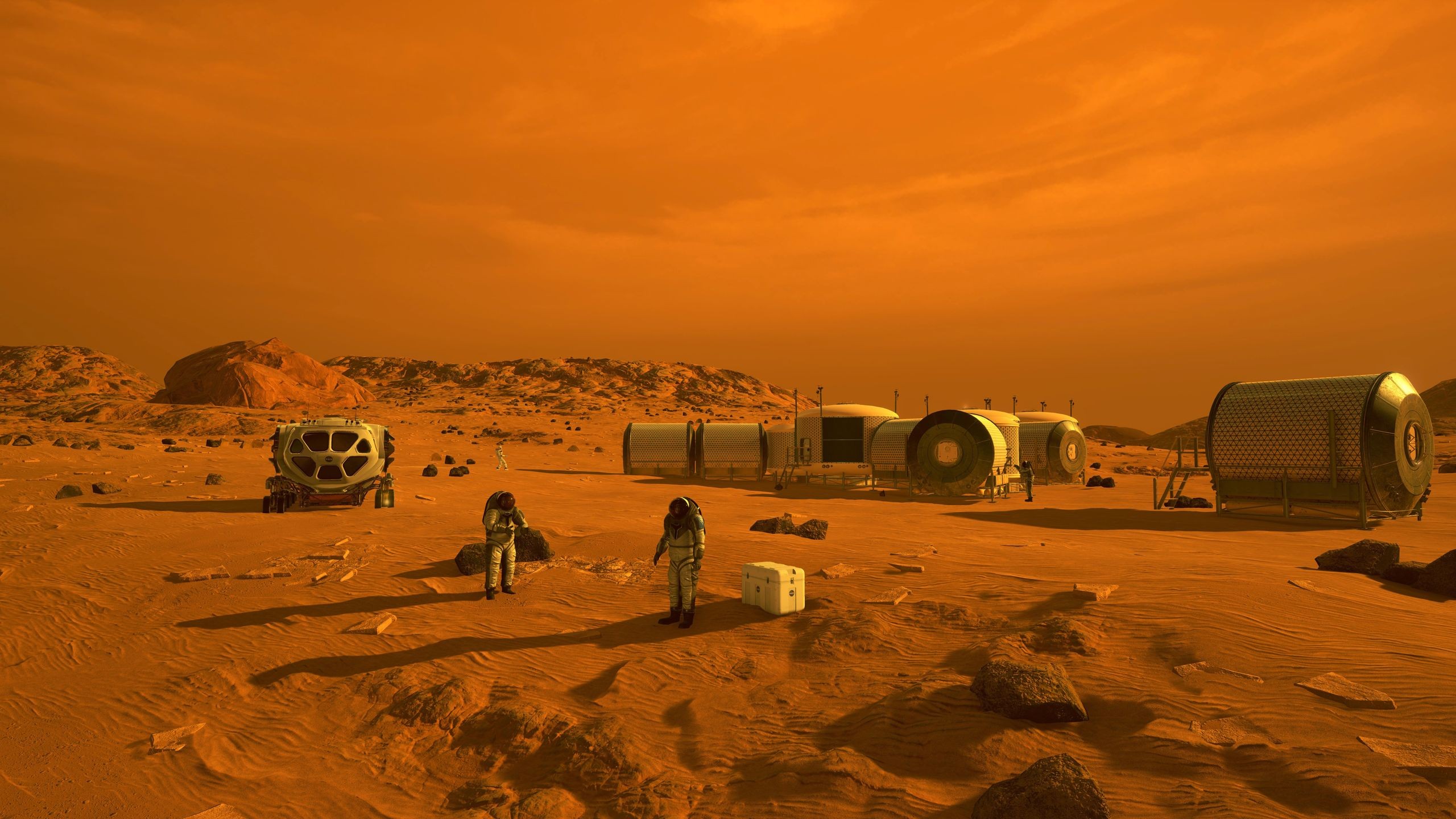
Antarctica is a nice place to visit, but nobody wants to live there permanently. Why would Mars be different? It’s colder. Dustier. Isolated. Newman argues Mars is not “Option B” for Earth’s failure. It is a destination for science, not escape.
Her vision? Small outposts.
NASA’s Artemis program fits this mold. Build a base near the lunar south pole. Use it as a stepping stone to Mars. Not for millions of settlers, but for researchers hunting for answers.
It’s a modest goal compared to science fiction novels. It’s also the one most likely to happen.
We Are Not Alone
The biggest question remains. Is there anyone else out there?
Newman is certain. She expects to find evidence of alien life within the next decade. Probably ancient life. Dead, but detectable.
Mars is a strong candidate. Rovers like Curiosity and Perseverance have already found complex organic molecules — the building blocks of life. If life exists here, we’ll find the fossil records.
“It’s probably going to be past life,” Newman says.
But don’t count out the outer solar system. Jupiter’s Europa and Saturn’s Enceladus hide massive oceans beneath their ice. Titan has liquid methane lakes and possibly a buried water sea.
David Brin bets heavily on the icy moons.
“I would bet 3 to 1 we find life under ice roofs.”
Finding life in two independent systems — Mars and Europa — would shatter our ego. It would mean life isn’t a fluke. It’s common.
“It would mean every star you see… has life.”
The Interstellar Leap
The microbes are step one.
Step two is intelligence.
We haven’t heard from anyone yet. Our radio window opened only 100 years ago. We are essentially shouting into a library before learning to read.
But the next 250 centuries change everything.
If we avoid societal collapse, Brin argues, we can send probes to other stars. Laser sailing technology could accelerate robots to significant fractions of light speed. Not humans. Not yet. But proxies.
We might meet aliens who sent lurker probes to our sun eons ago. Or we might finally crack the code of SETI signals.
Or perhaps the advanced civilizations are silent.
Newman suspects we will find out we aren’t unique long before we can greet them.
It’s an exciting uncertainty. The stars are waiting. We just need to make sure we survive ourselves to meet them.