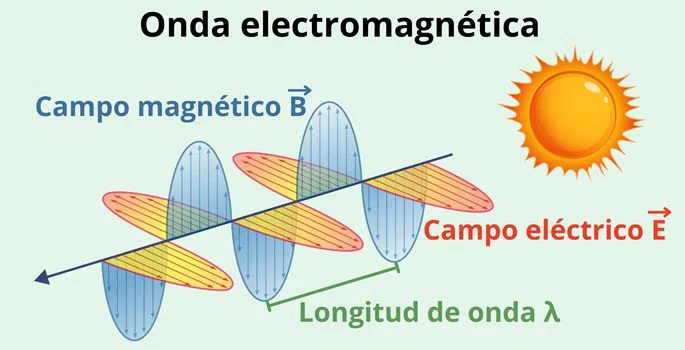
You can’t see them, touch them, or smell them, but they are everywhere. Electromagnetic waves are essentially a dance between electric and magnetic fields. These aren’t static forces. They are dynamic, rippling outward from moving charges. What actually oscillates in this process? The fields themselves. They pulse and shift in a synchronized rhythm that travels through space.
This phenomenon is not just a textbook diagram. It is the invisible infrastructure of your daily existence. Consider the light you are reading right now. It is an electromagnetic wave within the visible spectrum. Your eyes catch these specific frequencies and translate them into images. But that is only a tiny slice of the story.
Think about your phone. When you make a call or stream music, you are interacting with radio waves. These signals carry your voice and data across vast distances. They bounces off satellites and zip through the air. Without them, modern communication would collapse. Your car radio relies on the same principle to deliver news or songs. The technology is simple in concept but complex in application.
These waves vary in energy and frequency. Some, like radio waves, have long wavelengths and low energy. Others, like X-rays, are short and potent. Despite these differences, they all share the same fundamental nature. They move at the speed of light. They require no medium to travel. They can move through the vacuum of space.
Understanding how these waves work changes how you view the world. You realize that communication, sight, and even heat are all connected. The same physics that lets you watch a movie also allows a satellite to track weather patterns. It is a unified system. One that we often take for granted until it fails.
Why This Matters Now
We live in an age dependent on connectivity. Every device in your pocket is a receiver and transmitter of electromagnetic energy. This isn’t just about convenience. It’s about survival and progress. Medical imaging uses these waves to see inside the body. GPS relies on precise signal timing. Even the microwave in your kitchen uses a specific frequency to heat food.
The distinction between ionizing and non-ionizing radiation is critical here. High-frequency waves can knock electrons off atoms, potentially damaging DNA. Low-frequency waves, like those from Wi-Fi, generally do not have enough energy to cause such damage. Yet, public concern remains. The science is clear, but the perception is often clouded by misinformation. Knowing the facts helps separate fear from reality.
The Spectrum of Possibility
The electromagnetic spectrum is a continuum. It ranges from the longest, lowest-energy waves to the shortest, highest-energy ones. Radio waves sit at one end. They are used for broadcasting. Microwaves follow, used in cooking and radar. Then comes infrared, which we feel as heat. Visible light is a narrow band in the middle. We evolved to see it because it is abundant from the sun.
Beyond that lie ultraviolet rays. They cause sunburns but also help produce vitamin D. X-rays penetrate soft tissue, revealing bones. Gamma rays are the most energetic. They come from nuclear reactions and cosmic events. Each type has unique properties. Each has specific applications.
This diversity allows for a wide range of technologies. Fiber optic cables use light to transmit data at incredible speeds. This is different from wireless radio transmission but relies on the same wave principles. The evolution of communication has always been tied
Todo empieza con una carga eléctrica. No es magia física, es dinámica básica. Cuando una partícula con carga se acelera, las reglas cambian. Primero, genera un campo eléctrico. Ese campo empuja otras cargas cercanas. Pero la aceleración es lo que complica la historia. El campo oscila. Esa oscilación no se queda estática. Crea un campo magnético.
Aquí es donde la física se vuelve interesante. Los campos no mueren. Se alimentan mutuamente. Un campo eléctrico variable induce uno magnético. Y ese campo magnético variable, a su vez, regenera el eléctrico. Es un ciclo perpetuo. Se autopropagan. No necesitan un medio para viajar. Se mueven por el vacío. Esa es la razón por la que la luz del sol nos alcanza.
El espectro electromagnético explicado
No todas las ondas electromagnéticas son iguales. Hay una diferencia enorme entre una onda de radio y un rayo gamma. La distinción radica en la frecuencia y la longitud de onda. Juntos, forman el espectro electromagnético. Es el rango completo de radiación posible.
En un extremo, tienes las ondas de radio. Son largas. Frecuencias bajas. Usan menos energía. Al otro lado, están los rayos gamma. Longitudes de onda diminutas. Frecuencias altísimas. Mucho más energía. Todo lo demás está entre medio. Luz visible. Microondas. Infrarrojo. Ultravioleta. Rayos X. Cada tipo interactúa con la materia de forma distinta.
¿Por qué importa esta clasificación? Porque determina cómo usamos estas ondas. Las radios usan longitudes de onda largas para atravesar edificios. Los hospitales usan rayos X para ver huesos porque penetran el tejido blando. Los rayos gamma son peligrosos precisamente porque su alta frecuencia rompe enlaces moleculares. El espectro no es solo teoría. Es la herramienta que define nuestra tecnología.
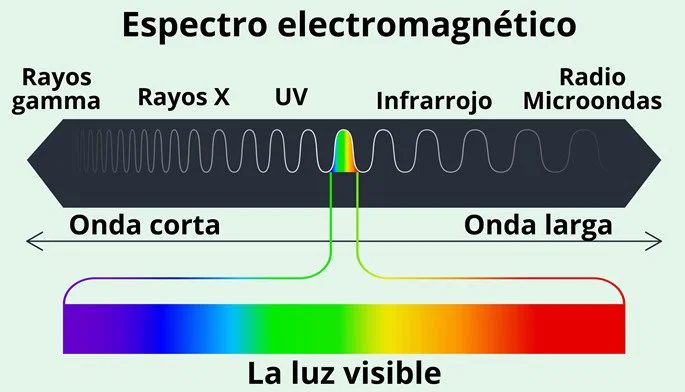

Short-wave radiation like X-rays and gamma rays is ionizing. That means it rips atoms apart. It travels as electromagnetic waves with enough energy to damage matter. This presence is dangerous to biological tissue.
Long-wave radiation is different. Its wavelength is huge, stretching for thousands of kilometers. These are mostly radio waves. They lack the energy to ionize. They are generally safe by comparison.
Key physics of electromagnetic waves
You need to understand the mechanics before diving into the spectrum. These waves have specific, non-negotiable traits.
- They do not need a medium. They move through vacuum and material alike.
- They are transverse waves. The oscillation direction is perpendicular to propagation.
- They are periodic. Oscillations repeat in equal time intervals.
- In a vacuum, speed is constant. It is the speed of light, approx. 3 x 10^8 m/s.
The wavelength is the distance between two adjacent peaks. We call it lambda (λ). Frequency is the number of cycles per unit of time. It is measured in Hertz. One Hertz equals one cycle per second.
These waves result from electromagnetic signals. Simple as that. But the implications for technology are massive.
Examples of electromagnetic waves
Classification depends on wavelength and frequency. The spectrum is vast. Each band has unique properties and uses.
Radio waves
Radio waves sit at the low-energy end of the spectrum.
- Frequencies: 300 GHz to 3 kHz.
- Wavelengths: 1 mm to 100 km.
- Speed: Up to 300,000 km/s on Earth.
We rely on artificial radio waves for satellite communications. They power telecommunications. They drive radar systems. They enable navigation. They connect computer networks.
Commercial radio uses AM and FM bands. AM ranges from 540 to 1600 kHz. AM stands for amplitude modulation. FM ranges from 88 to 108 MHz. FM stands for frequency modulation.
Nature generates radio waves too. Lightning strikes produce them. Astronomical phenomena create them. We just learned to harness them.
Microwaves
Microwaves have shorter wavelengths than radio waves. The prefix “micro” hints at that size difference.
- Frequencies: 300 MHz to 300 GHz.
- Wavelengths: 1 meter to 1 mm.
- Speed: Light speed in vacuum.
We use them for television transmission. They support cellular networks. They enable cordless phones. They power walkie-talkies. They heat food in microwave ovens.
The range is tight. High enough to carry data, low enough to be contained.
Infrared waves
Infrared waves sit between microwaves and visible light. They are heat radiation.
- Frequencies: 300 GHz to 400 THz.
- Wavelengths: 0.00074 mm to 1 mm.
We can split infrared into three sub-categories.
- Far infrared : 300 GHz to 30 THz. Wavelengths from 1 mm to 10 µm.
- Mid infrared : 30 to 120 THz. Wavelengths from 10 to 2.5 µm.
- Near infrared : 120 to 400 THz. Wavelengths from 2500 to 750 nm.
Remote controls use near-infrared. Thermal cameras detect mid and far-infrared. The sun emits it heavily.
Visible light
Visible light is the slice of the spectrum humans can see. It is surprisingly narrow.
- Frequencies: 400 to 790 THz.
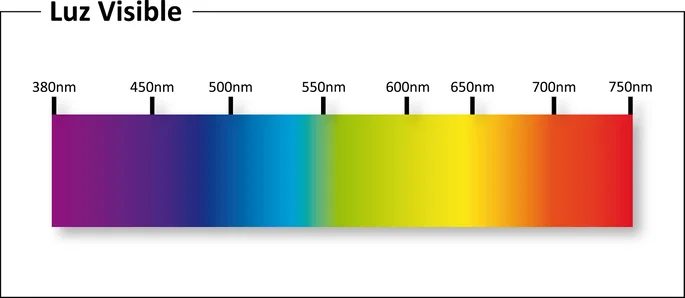
- Wavelengths: 380 to 750 nm.
Red sits at the lower frequency end. Violet at the higher. This is the only part of the electromagnetic spectrum that evolved eyes to detect. For billions of years, it has been our primary source of information about the world.
We take it for granted. It illuminates our screens. It drives photosynthesis. It allows us to read this sentence.
Beyond visible light, the spectrum continues. Ultraviolet. X-rays. Gamma rays. The boundaries blur. Energy increases. Danger increases. Utility changes.
The distinction between ionizing and non-ionizing radiation is not just academic. It dictates how we design shielding. It determines what medical procedures are safe. It influences how we build our communication infrastructure.
One question remains. As technology pushes frequencies higher, do we understand all the interactions? The physics is clear. The applications are growing. The gaps in knowledge are shrinking, but they still exist.

How We See and What We Can’t: The Science of Light and Radiation
Light is fundamentally an electromagnetic wave. It doesn’t just appear; it travels with specific physical constraints. We are talking about frequencies ranging between 400 and 790 terahertz. The wavelengths sit comfortably between 390 and 750 nanometers. It moves at 300,000 kilometers per second. That is the speed limit of the universe for this particular type of energy.
Where does this visible light actually come from? It is produced by the vibration and rotation of atoms and molecules. It also results from electronic transitions within those same structures. The colors we perceive are not arbitrary. They correspond to narrow bands of wavelength.
- Violet : 380 to 450 nm
- Blue : 450 to 495 nm
- Green : 495 to 570 nm
- Yellow : 570 to 590 nm
- Orange : 590 to 620 nm
- Red : 620 to 750 nm
This specific range is all humans can see. It is a tiny sliver of the broader spectrum. But what happens just outside those limits? The invisible regions are where things get complicated.
Why Ultraviolet Radiation Matters for Human Health
Ultraviolet (UV) light is electromagnetic radiation with shorter wavelengths than visible light. It is classified into four distinct categories based on energy and penetration depth.
- Near UV : 300 to 400 nm
- Middle UV : 200 to 300 nm
- Far UV : 200 to 122 nm
- Extreme UV : 10 to 122 nm
This radiation drives chemical reactions. It causes fluorescence in many substances. The extreme UV is ionizing. It strips electrons from atoms. This type of radiation is blocked by atmospheric oxygen. It never reaches the surface.
The ozone layer handles the next tier. It absorbs UV between 280 and 315 nm. Without this shield, the damage to living beings would be catastrophic. Only about 3% of solar UV actually makes it to the ground.
Humans cannot see UV light. We feel it. We feel it when our skin tans. We feel it when it burns. Prolonged exposure leads to serious consequences. Skin cancer is a direct result of this damage.
Yet, we need it. Humans and other life forms require UV in the 295–297 nm range to produce vitamin D. It is a balancing act. Too little, and we suffer deficiencies. Too much, and we risk cellular destruction.
Understanding X-Rays and Their Ionizing Power
X-rays are electromagnetic waves with significantly higher energy than UV. Their characteristics place them firmly in the dangerous category for biological tissue.
- Energy range : 100 eV to 100,000 eV
- Frequencies : 30 petahertz to 30 exahertz
- Wavelengths : 0.01 to 10 nm
The photons in this band have enough energy to ionize atoms. They can break molecular bonds. This makes them harmful to living organisms. They are useful for imaging because they pass through soft tissue, but they do not discriminate. They damage DNA.
Gamma Rays: The Highest Energy Waves
Gamma rays represent the upper limit of the electromagnetic spectrum. They are the most energetic waves known.
- Energy : Above 100 keV
- Frequency : Greater than $10^{19}$ Hz
- Wavelength : Less than 10 picometers
These were discovered by Paul Villard in 1900. He was studying radiation emitted by radium. The source is radioactive materials. The energy involved is so high that it alters the very structure of matter.
The spectrum continues. From the gentle vibration of atoms creating visible color to the violent ionization of gamma rays. We live in a world bathed in invisible forces. We have learned to harness the useful bits. X-rays