


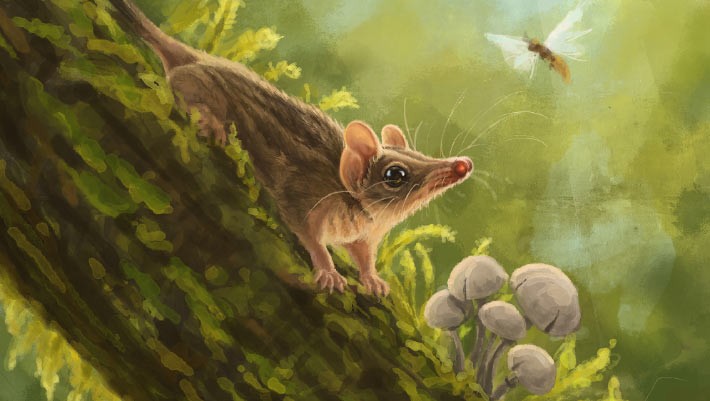
We thought we knew the timeline for Australian carnivorous marsupials. We didn’t.
A new fossil find in Queensland has shifted the clock back by millions of years. Paleontologists from the University of New South Wales have identified Miyumba chrisdickmani. It’s a tiny creature. It lived 18 million years ago. It belongs to the dasyurid family, which includes today’s quolls and Tasmanian devils.
This discovery proves that dasyurid marsupial origins go deeper into the Early Miocene than anyone had evidence for.
Why the Riversleigh Fossil Changes the Family Tree
The bones were found in the Riversleigh World Heritage Area. Northwestern Queensland. A place famous for holding secrets of the ancient past.
The team, led by Dr. Timothy Churchill, didn’t just find a jaw. They found several partial lower jawbones. They used micro-CT scanning. This allowed them to see teeth structures in high resolution.
Here is the problem they solved: until now, no single dental trait clearly defined dasyurids. It was messy. Complicated. Close relatives looked similar.
Miyumba chrisdickmani changed that.
The researchers found a shared dental feature. It appears in all dasyurids. It’s the first reliable anatomical marker uniting the entire family.
The fossil itself is small. About 23 to 33 grams. Think modern antechinuses or dunnarts size. It lived in lush rainforests. Not the dry scrub we imagine for ancient Australia.
When Did Dasyurids Actually Evolve?
Genetic data from living species meets fossil anatomy. The result is a revised timeline.
Previous estimates placed the start of the dasyurid lineage later. Now, researchers say it began around 25.6 million years earlier. That is a three-million-year shift.
Miyumba chrisdickmani sits at the base of this tree. It branched off before any other known dasyurids.
It is the oldest. The most primitive member found so far.
Dasyurids are a big deal in the Australian ecosystem. They are the most species-rich family in the order Dasyuromorphia. Seventy-seven living species exist today across 21 genera.
Yet, the fossil record had only shown us 20 species in eight genera from later deposits. We were missing the start.
Why Did This Lineage Move to New Guinea?
The teeth tell a story of migration. Or rather, survival.
Miyumba chrisdickmani shares dental similarities with modern marsupials in New Guinea. Specifically, species like Murexia. These live in New Guinea’s rainforests today.
Australia changed. Its forests contracted. They dried out over millions of years.
New Guinea stayed wet.
“New Guinea has retained extensive rainforest cover since Miocene, preserving a faunal that likely reflects the ecological structure Sahul’s former lowland.”
The scientists believe Miyumba chrisdickmani represents an early branch. Its descendants may have hung on in New Guinea while the Australian mainland became too dry.
It’s not just this species. Several marsupial lines were once spread across Sahul. Now they are restricted to New Guinea.
How many other ancient stories are hiding in those equatorial forests?
The paper lands in Australian Zoologist. Published July 17.
The family tree has new roots. And they are deeper than we knew.


