Poker dice isn’t just random chaos. It is a structured game of deception and luck wrapped in five tiny cubes. The goal is simple enough to grasp in seconds. You want to roll the best possible hand.
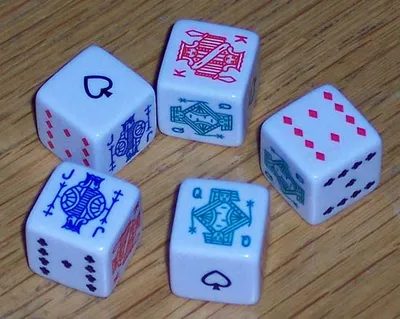
But these aren’t standard dice. They mimic a deck of cards. The six faces represent the top six cards of a playing deck. You have the ace, king, queen, jack, 10, and 9. No eights. No sevens. Just the high rollers.
The mechanics feel familiar if you have ever sat around a table with a deck of cards. You throw the five dice. Then you make a choice. Stand pat. Or draw.
When you choose to draw, you separate the dice showing your best symbols. You keep those. You roll up to three dice again. The result is final.
There are no flushes in this version. That makes it distinct from card poker. Your hand rankings follow standard poker logic. But there is one major exception. Five of a kind is the highest possible hand. It beats a straight. It beats a full house. It rules them all.
The Liar’s Game
There is a variant that changes everything. It introduces bluffing. The game is called liar dice. Or sometimes just liar’s dice.
In this version, players hide their throws. They announce their hand. They might tell the truth. They might lie.
The second player is the caller. Or the doubter. They have a choice. Attempt to beat the announced hand. Or call the bluff.
If the caller is right about the bluff, they win. If they are wrong, they lose. It adds a layer of psychological warfare to the dice rolling.
A Historical Snapshot
This game has been around for a long time. Records trace poker dice back to the latter half of the nineteenth century. It was a popular pastime before the digital age.
Several variants exist. Spanish poker dice uses different rules. It also uses eight-sided dice. The faces include ace through seven. It expands the range of possible hands.
You can also play with ordinary six-sided dice. It requires a mental mapping. The sides count in descending order. One is an ace. Six is a king. Five is a queen. Four is a jack. Three is a ten. Two is a nine. It works. It just requires you to remember the ranking.
The Legacy
The game evolved. It gave birth to Yahtzee. If you have played Yahtzee, you have played poker dice in disguise. The mechanics are nearly identical. Keep some dice. Reroll others. Aim for a high score.
Some versions have quirky rules. Horses is one such variant. In horses, five aces is not the winning hand. It actually loses. It reverses the standard hierarchy. Why? Tradition. Or maybe just to keep things interesting.
It is a niche game now. You won’t find it at every casino. But it survives. It lives in board game collections. It lives in the memories of people who prefer dice to cards.
The appeal is clear. It is fast. It is simple. But it has depth. You learn the odds. You learn to read your opponent. You learn that sometimes the best hand is not