He didn’t just play music. He invented the vocabulary.
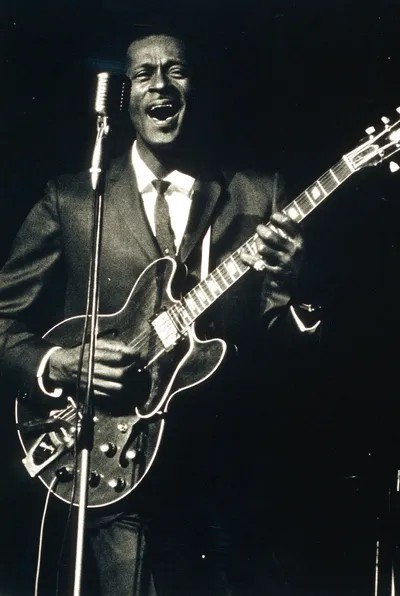
Thanks to Chuck Berry, the guitar has six strings and rock and roll feels like a dialogue between rhythm and blues. Born in St. Louis on October 18, 1926, this working-class working-class child became one of the most influential forces in popular music for decades. He died on March 18, 2017 in St. Charles County, Missouri. This is about 90 years of influence condensed into one person’s life.
His story didn’t start with fame. It starts with blood. Berry was proud of his African American and Native American heritage and grew up in a community that was not fully integrated. He heard it all. The Antioch Baptist Church choir provided him with gospel harmonies. Radio brought him the rawness of blues and the twang of country-western. Sumner High School added formal music classes Even though he was still in high school, he was already immersed in everything.
But the path wasn’t straight.
He was involved in an armed robbery when he was still a student. The court transferred him to a juvenile delinquent prison in Missouri. Three years gone. He returned to St. Louis with a record and a chip on his shoulder. He worked at an auto plant. He studied hairdressing. He cut hair to pay the bills.
“He played music in small nightclubs.
That last part is important. While working during the day, he honed his skills in smoky clubs. He wasn’t performing for stadiums. He plays for anyone who walks in the door. It was gritty. It was real. It sets the stage for what came next. Although the rock and roll architect was little known to the rest of the world, he made a name for himself in the nightlife.
Chess record breakthroughs and early favourites
Berry didn’t just find a breakthrough, he chased it down. He chased it down in Chicago. Muddy Waters introduced him to the Chess brothers Leonard and Phil, who signed him to their label. From that meeting in 1955, gave us Maybellene. This is a country and western flip of the original song “Ida Red”. The song stayed on the pop charts for 11 weeks. It rose to 5th place. That was just the start.
He didn’t stop there. Tours and hits followed. “Roll Over Beethoven” was released in 1956 and “School Day” in 1957. “Rock’n’Roll Music” was also released. Then came the Blitz of the late 1950s. 1958’s “Sweet Little Sixteen,” “Johnny B. Goode,” and “Reelin’ and Rockin’.” These aren’t just songs. They were blueprints.
His lyrics capture consumer culture and teenage life in sharp, vivid detail. This sound comes from the rhythmic and melodic work of his guitar and the rhythmic, melodic work of his piano player Johnny Johnson. Every rock band has needed these staples ever since.
Legal problems and the British invasion
Peak popularity has a dark side. Federal authorities charged Berry with violating the Mann Act. The charge? Transporting a underage female across state lines for immoral purposes. These trials had racist overtones. He was convicted and sent to prison.
His relevance did not end in prison. He came back and placed new hits for the charts. No Particular Place to Go was released in 1964. It arrived right in the middle of the British Invasion. The Beatles, Rolling Stones and Beach Boys were all major influences on his work.
He had his first No. 1 single in 1972 with “My Ding-A-Ling.” Recordings were made occasionally in the 70s and 80s. He kept showing up in concerts with the support of local musicians. In 1987, his public profile jumped. His autobiography has been published. The documentary Hail! Hail! Rock ‘n’ Roll, which includes footage from his 60th birthday concert, is released. featuring Keith Richards and Bruce Springsteen.
Rock architect
Berry is one of the most influential figures in rock history. He helped create rock and roll from rhythm and blues. He combines witty lyrics with a unique guitar sound. A boogie-woogie rhythm forms the basis of the song. His language was spot on. The stage show is amazing. He incorporated elements of country-western and blues music.
He is not only technically brilliant; He was smart about tone. He used electronic effects in his recordings to imitate the ringing sounds of bottleneck blues guitarists. His compositions cover a wide range of genres. He showed great interest in Caribbean music with songs such as “Havana Moon” (1957) and “Man and the Donkey” (1963).
Who influenced him? He studied guitarists such as Carl Hogan, Charlie Christian and T-Bone Walker. He listened to singers such as Nat King Cole, Louis Jordan and Charles Brown. This wide range helped broaden the appeal of rhythm and blues in the 1950s.
“His recordings have a rich repository of lyrical and musical building blocks that are at the heart of rock and roll.”
He wrote the lyrics to appeal to the growing teenage market. High school life. Teen dances. consumer culture. It’s all there, expressed with humor and vivid descriptions. The result was a series of recordings that defined the genre.
His songs were covered by the Beatles and the Rolling Stones. So did Elvis Presley. Buddy Holly. Linda Ronstadt. Many important pop music performers have recorded his songs. The list continues to grow. The influence remains.
Chuck Berry didn’t just play music. He defines it. This importance has also been demonstrated in space. literally.
His song “Johnny B. Goode” is engraved on a gilded copper plate. The disc is on the Voyager 1 spacecraft. The spacecraft was launched in 1977 and is sending messages to the stars. Future civilizations might hear it. Or strangers far away. Either way, they get a piece of 20th century global culture. Berry’s guitar riff is part of the package.
Industry is also paying attention. In 1984, he received a Grammy Lifetime Achievement Award. 3 years later. In 1986, he was inducted into the Rock and Roll Hall of Fame.
He was a legend even before his nameplate appeared. But these tributes confirm it. Music travels light years. This recognition is very familiar.
How many artist voices pass through the heliosphere? Not many. Berry’s influence was limitless. His legacy is eternal. The silence of space has a soundtrack. It’s him.