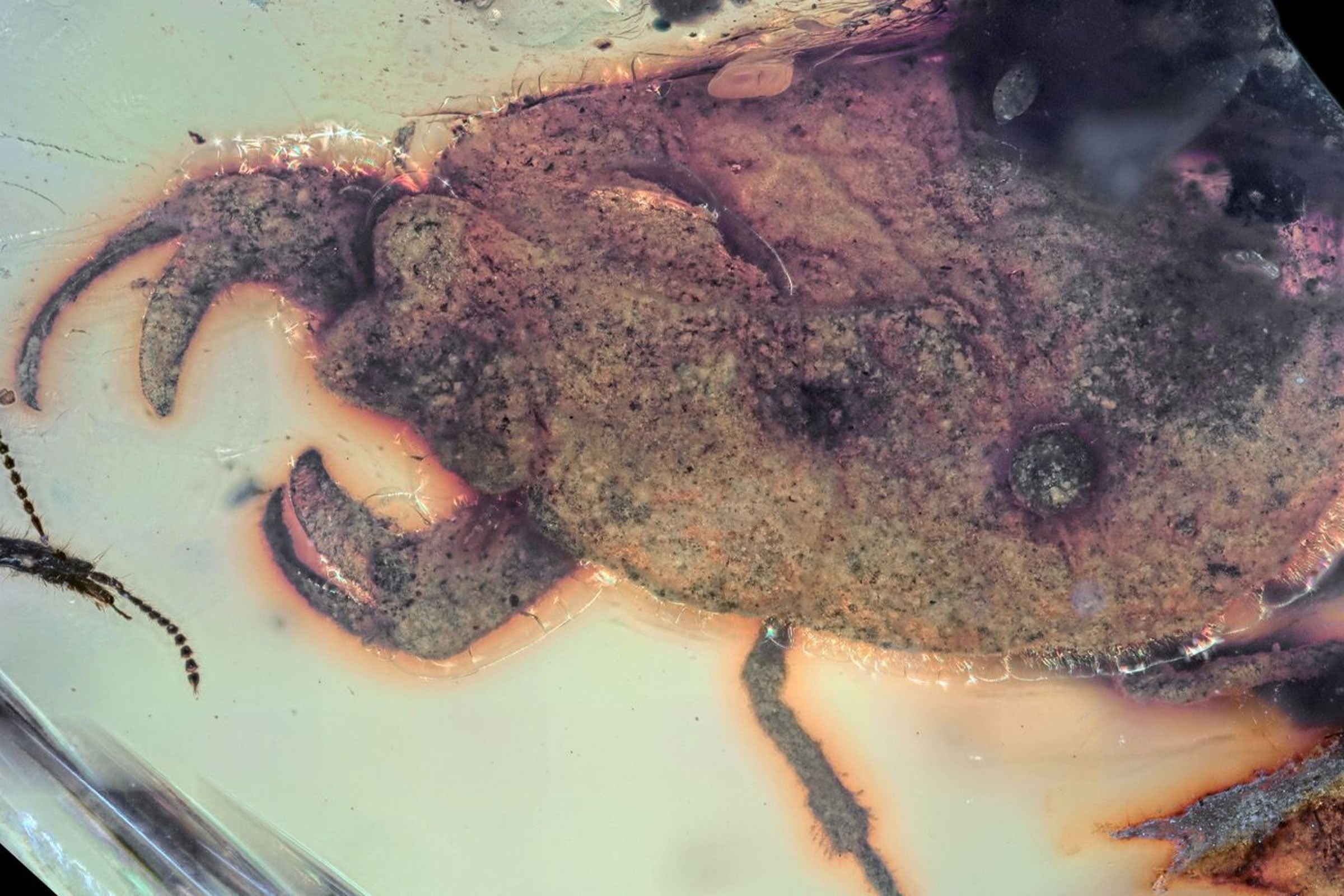
Amber doesn’t lie. Not usually. From the Kachin region in Myanmar it keeps pouring out secrets about a world that vanished 100 million years ago, a Cretaceous snapshot where animals we’ve never met lived their lives. This time it’s a true bug. It has giant claws.
Researchers at LMU found the specimen and called it strange. Mostly because insects rarely have pincers that look like crab legs. The structures, technically known as chelae, function like forceps. Grasping. Pinching. Holding. In the bug world this is an extreme rarity.
Previously such chelae were only documented in three insect groups.
This fossil? It’s the fourth. Which means nature had to invent this feature from scratch. Again. An independent evolutionary detour that just happened to converge on the same solution. Crabby legs on an insect. Why not.
Carolin Haug and her crew used micro-CT scanning to slice the fossil digitally, reconstructing the anatomy in three dimensions. No chiseling required, no breaking of precious rock. Just data. They published the findings in the journal Insects, but before that they ran numbers. Quantitative morphological analysis sounds dry until you realize they compared over 2,000 similar grasping structures across living and dead species. The result? The true bug’s claws didn’t fit the pattern of other bugs at all. They matched distantly related arthropods more closely, things like decapods or even tanaids. Crabs. Lobsters. Shrimp relatives. The shape was distinct. Alien almost.
Stray Kids save the day
Naming a creature is always part science part branding. For this one the team coined a genus and species that reflects both its form and a pop-culture twist. They named it Carcinonepa libererrantes. The first part comes from Greek and Latin, merging “crab” with a reference to true water bugs, Nepomorpha. It makes sense biologically. It looks like a crab bug.
The species name though? That’s pure fandom. Libererrantes is a Latinization of Stray Kids, a massively popular K-pop group. Fenja Haug one of the paper’s authors happens to love the band. When they looked at how the fossil’s front claws were posed, the resemblance was striking. The trademark hand signs. The fierce stance.
The posture of the chelae strongly resembles Stray Kids’ signature pose.
So there we are. A 100-million-year-old predator named after boy band members. Who could argue with the accuracy.
Biologically Carcinonepa libererrantages sits within the true water bugs. Specifically the Nepomorpha group. Beyond those weird claws it looks a lot like modern Gelastocoridae. Toad bugs. They are terrestrial predators now, hiding in leaf litter and ambushing prey. It is likely our amber specimen lived the same way. Hiding. Waiting. Snatching small insects with those massive pincers near a coastal Cretaceous forest edge.
We have a fossil. We have a name. We still have no idea where the body ended up after it was preserved. Or where the song takes us next.