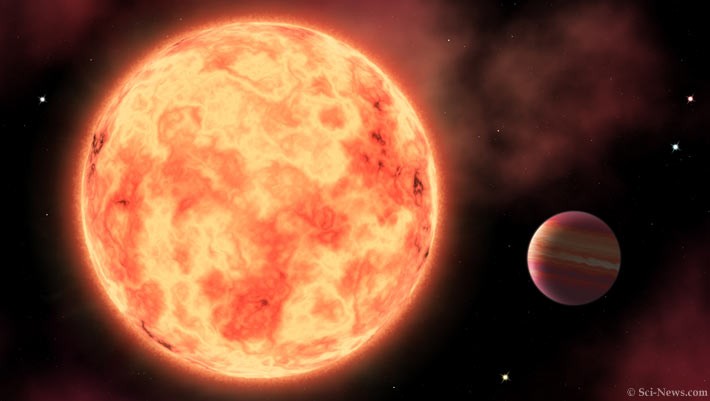
It is out there.
Just 330 light-years distant, sitting in the messy bits of the constellation Dorado. The star is unremarkable, a standard G-type. But it has company. Two heavy worlds orbit it. One is the focus of intense scrutiny right now. TOI-199b is the name.
Think Saturn, but warmer.
This isn’t a frozen rock drifting through the dark, nor is it a scorching hell-hole close to the sun. It sits in that comfortable, temperate zone. The planet gets 2.5 times the radiation we receive on Earth. That translates to 174°F. Hot bath, but livable for gas giants. It circles its star every 105 days.
Mass-wise, it is about 0.17 of Jupiter. Size-wise, 0.81 of Jupiter. A fluffy, hydrogen-heavy sphere.
“TOI-199b stands as one of the best places to look for atmosphere,” said Renyu Hu from Penn State.
They wanted proof. Theories are fine, but data is king.
Using the Near-Infrared SpectroGraph on the James Webb Space Telescope, they watched the star’s light slip through the planet’s edge during transit. It’s a classic trick. Transmission spectroscopy. If molecules absorb specific wavelengths of light, they leave a fingerprint.
They found the print. Methane.
“We saw the atmosphere block the specific colors methane drinks up,” Aaron Bello-Arufe noted.
Models said temperate gas giants should hold onto methane. Webb confirmed it. The theories worked. That is satisfying, even if it was expected.
But methane was not alone. The data whispered of ammonia. And carbon dioxide. Just hints so far, not a full inventory.
“We need more eyes on this to balance the ledger of gases,” Hu added.
Why bother? Why stare at a ball of gas half a million miles away?
Because understanding how these atmospheres form might teach us how ours did. Or didn’t. It sharpens the models. It tests our grasp of planetary evolution.
“Now we can spend more time studying these places to see if TOI-199b has a soulmate,” the team said. “Or if it is a loner.”
The findings hit the Astronomical Journal on May 20. The work was published in 2026 by Aaron Bello-Arufe and colleagues.
It’s just the start. Webb keeps looking.