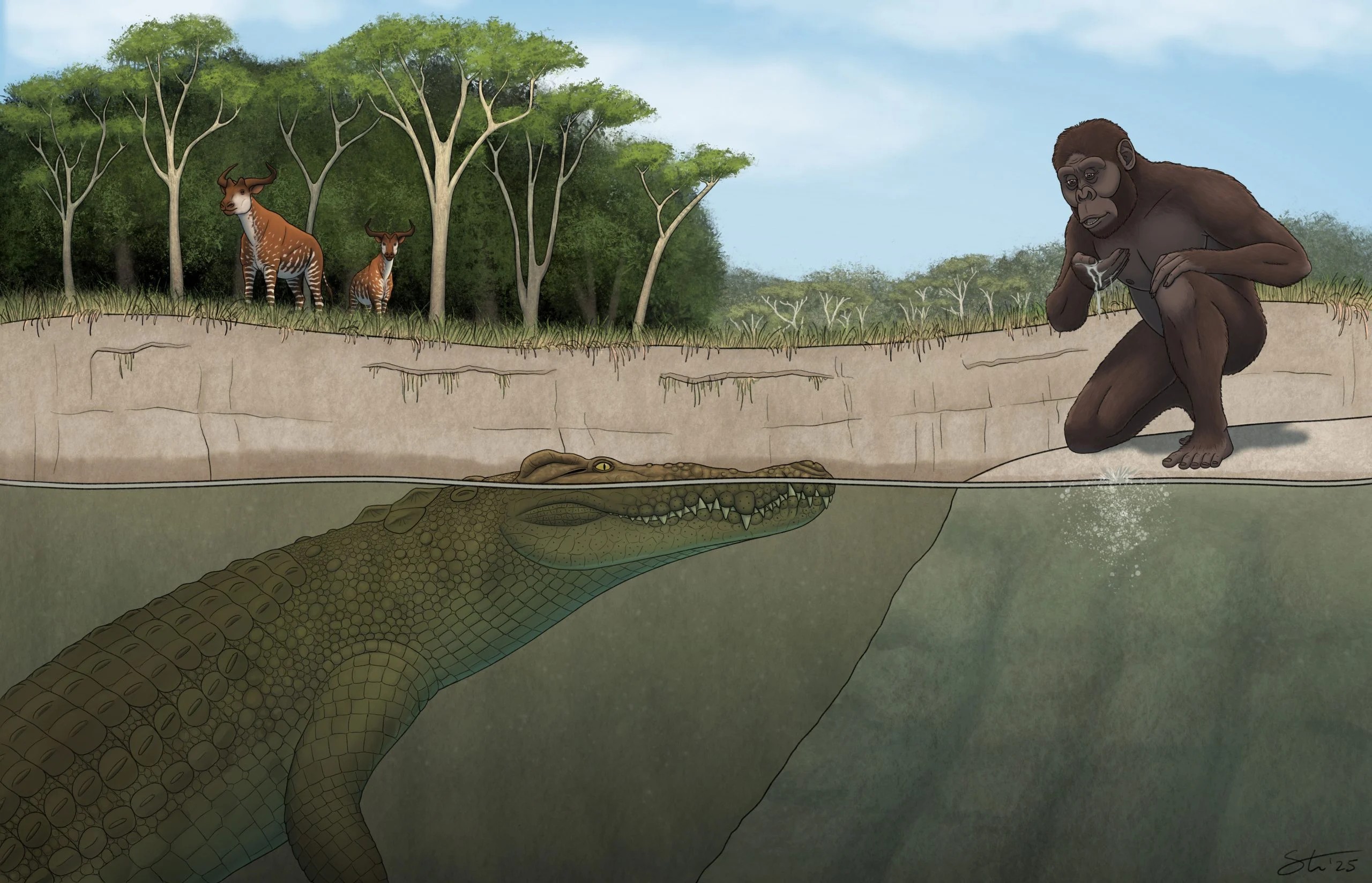
Three million years ago. Lucy is walking.
She doesn’t know it yet, but there is something in the water. Waiting. It has a weird bump on its face.
A University of Iowa team found out who it was. They named it Crocodylus lucivenator. Which, honestly? Kinda translates to “Lucy’s Hunter.” It feels a bit dramatic, but accurate enough for the Pliocene wetlands of Hadar, Ethiopia. This croc didn’t just exist nearby; it dominated. It lived from 3.4 to 3 million years ago, overlapping perfectly with Australopithecus afarensics, Lucy’s species.
Lucy was important, of course. Found in 1974. Oldest complete ancestor skeleton for a while. Proved that standing on two legs came before brains got big. But while Lucy was figuring out bipedalism, her environment was ruled by teeth and water.
Size matters
How big were we talking? Roughly 12 to 15. Maybe a foot or two longer.
Weight wise? Adults tipped the scales at 600 to 1,300 lbs. It wasn’t just another reptile. It was the top predator. Forget the lions and hyenas of the savannahs. In the riverine shrublands of Hadar this crocodile was king. It hid under the surface, silent. Ambush mode. Animals come for a drink they get lunched.
“It’s a near certainty this would have hunted Lucy’s kind.”
That’s Christopher Brochu. He teaches earth sciences at Iowa. He wrote the paper. He doesn’t say they did catch Lucy. We can’t know that. One skeleton doesn’t tell a story about every individual meal. But the intent? There it was. Dinner was on the menu.
The face gave it away. Well. The snout did.
Brochu spent 35 years studying ancient crocs. In 2016, he was in Addis Ababa. Museum visit. He looked at these bones and his jaw basically hit the floor.
The hump.
Right in the middle of the snout. Nile crocodiles? No. American crocodiles? Yes. It’s a display trait. Males lower their heads. Show off. Flirt with females maybe? We don’t judge. But the science says that hump was for signaling.
There was also an extra-long bit past the nostrils. Very modern looking. Elongated. Unlike its neighbors.
Bone bruises and battles
The team didn’t just find one tooth. They got 121 fossils. Skulls. Jaw pieces. Dozens of individuals. Most were fragments, like finding a jigsaw puzzle scattered across three counties. But some told better stories.
Stephanie Drumheller looked closely at one skull. She’s at Tennessee now but did her PhD in Iowa. She found healed injuries. Bite marks. Old ones. Fresh? No, old. The animal survived a fight. With another crocodile probably.
Face biting is a classic move. Winner or loser? We don’t know who won. We only know the fighter walked away.
Hadar itself is special. A UNESCO World Heritage spot. Woodlands. Galleries of trees along rivers. Grasslands that turned into wet marshes over time. While three other croc species hung out farther south in the Rift Valley, Lucy’s Hunter owned this patch of ground. No competitors. Just it, the water, and whatever dared to drink.
It lasted. Through changes in climate, through shifting habitats, it persisted. Maybe because it was so damn efficient. Or maybe because no one else could fill its niche.
Why do we care about a dead croc from millions of years ago?
Probably because we like imagining our ancestors in peril. It adds tension to the narrative of human evolution. We weren’t just strolling upright in safety. We were snacks. Potential snacks. The landscape was wetter then, darker, hungrier.
The money for this work came from NSF, the Leakey Foundation. USIP at Iowa too.
We still don’t have the body. Not really. Just impressions of bones in rock. A hump here, a healed wound there. A guess about mating displays. The rest is water, lost to time.