Imagine the fourth crewed flight to Mars. You are on the Odyssey.
The launch felt anti-climactic. The spacecraft eased away from Earth. So gradually. You might check your watch. Wondering if the engines died.
They did not die. They are just patient.
Electric propulsion does not explode. It pushes. Steadily. After a week of that quiet thrust the Odyssey is doing 400,001 kilometers an hour. That is fast. Faster than almost anyone has moved in history. And you are only just getting started.
That trip is likely ten years off. NASA is laying tracks for a train that has not been built yet. They want to send humans to Mars faster. And cheaper.
The trick is power.
A Record Broken with Liquid Metal
The latest test hit a wall. Or rather smashed it.
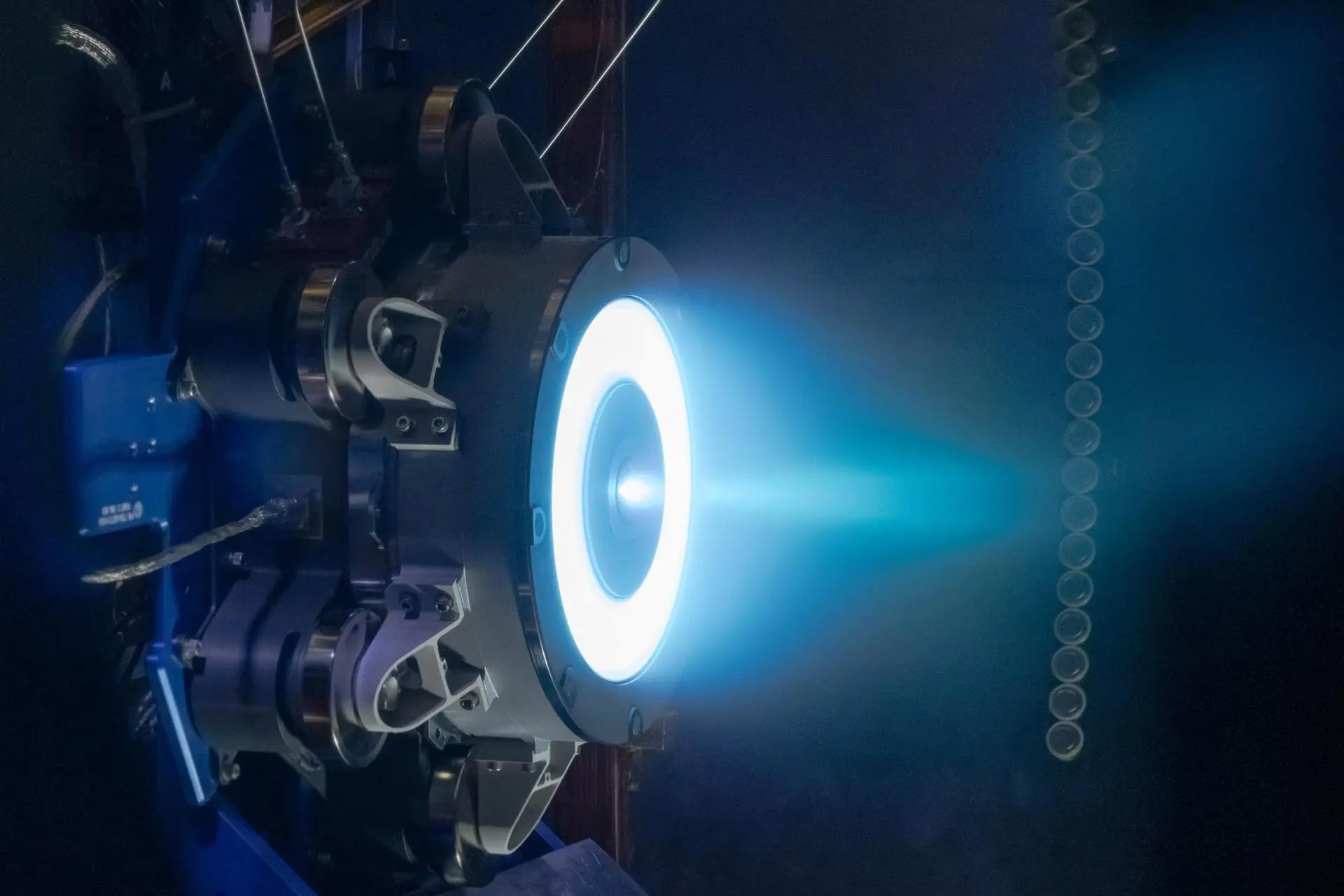
A new thruster design set a US record of 120 kilowatts. For context? Look at NASA’s Psyche spacecraft. It is heading to asteroid 16 Psyce right now. It carries the strongest electric thrusters in orbit today. But this new engine is twenty-five times more powerful than what Psyche is using.
Psyche tops out around 135.000 kilometers per hour. The new lithium engine aims much higher.
Why the difference in speed? Time. Electric engines accelerate constantly. They sip fuel instead of guzzling it. Chemical rockets? They dump huge tanks of propellant in a burst. Efficient? Not really. Electric systems save up to 90% on fuel compared to old-school chemical burns.
The fuel here is not a gas like xenon. It is lithium. Vaporized metal.
“Designing and building these thruster took years.” said James Polk at NASA’s Jet Propulsion Lab. “It’s a huge moments. We hit the power we targeted. We know the testbed works.”
He sounded relieved. He sounded happy. Good.
The Heat is On
Twelve-hundred watts sounds loud. It isn’t loud enough for Mars.
A real human mission needs 2 to 4 megawatts. That is hundreds of thrusters. Working together.
For how long? 23.000 hours.
Do the math. That is about 958 days. Two point six years.
You cannot run an engine at those temperatures for nearly three years without it melting. Or exploding. Or just quitting.
The lithium thruster survived tests at 2.800 degrees Celsius. Five thousand degrees Fahrenheit. That is hot enough to melt stone. But it is not hot enough to defeat Mars yet. Not with current scaling.
Why take two point six years? Orbits.
Mars and Earth align only every twenty-six months. The window opens. You go.
The Long Wait
Traditional robotic probes take six to seven months. Easy. They don’t carry food. They don’t need water. They don’t get bored.
Humans need things. Big spacecraft. Heavy life support. Lots of fuel for the return trip.
Here is the itinerary if we leave when the window opens:
– Six to nine months to Mars
– Eighteen months waiting on the red dust for the window to align
– Six to nine months home
Electric propulsion could change those numbers. Less fuel means less mass. Less mass means maybe a faster ride? Or maybe just more supplies? We do not know yet.
We are burning metal in a vacuum and seeing how fast the spark jumps. It works. It is slow. But it might get us there.
Or maybe not.
Only time will tell. And that is why we do science.
The engines are humming. The lithium is boiling. Someone is watching.