China’s space program has successfully replenished its orbital outpost, with the Tianzhou 10 cargo spacecraft delivering nearly seven tons of supplies to the Tiangong space station. This mission marks a significant logistical milestone, not only by restocking the station with essential propellant and scientific equipment but also by delivering the final component of a new generation of spacesuits designed for complex extravehicular activities.
A Swift and Successful Resupply Mission
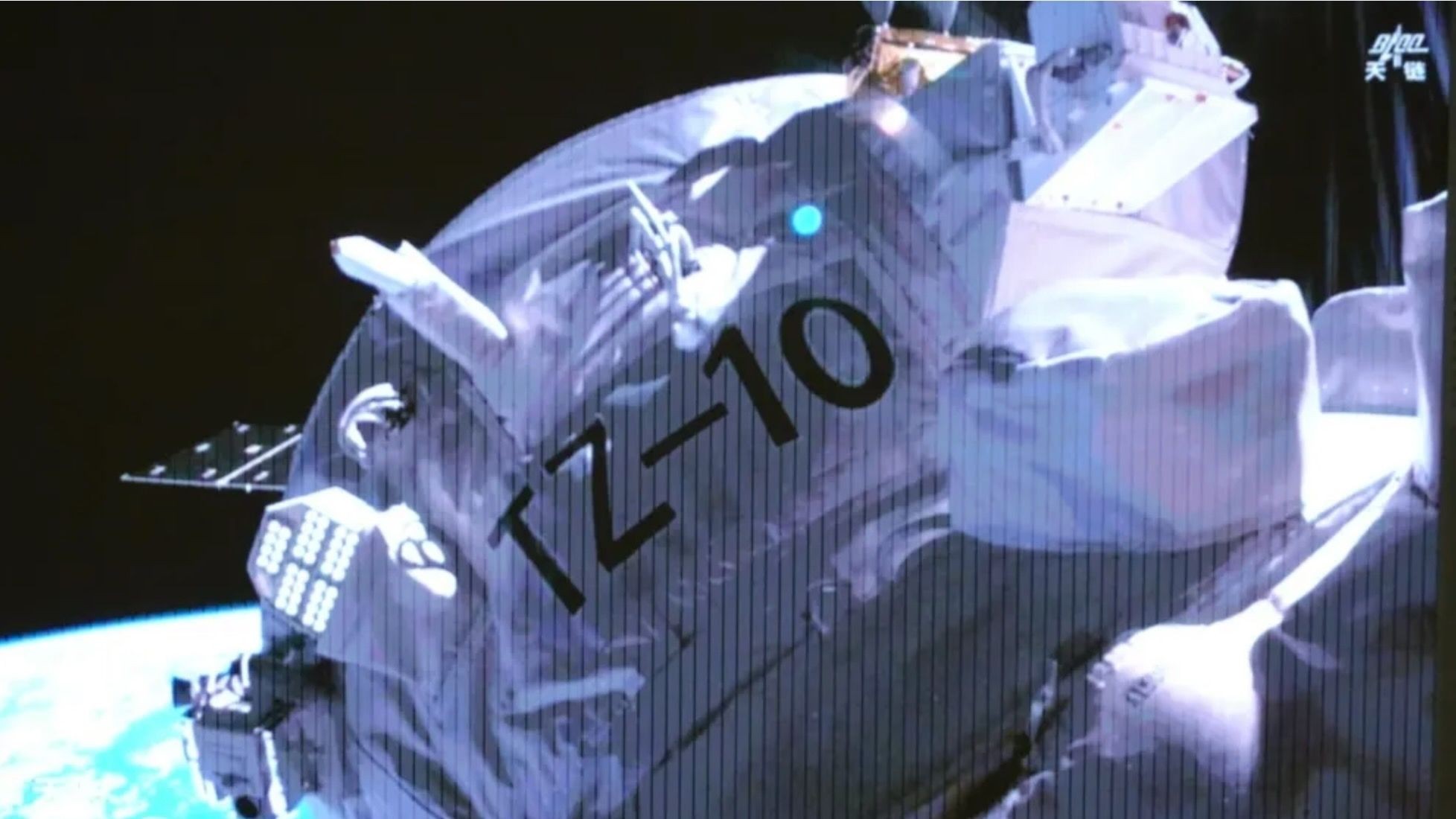
The Tianzhou 10 freighter launched atop a Long March 7 rocket from the Wenchang Space Launch Site on Hainan Island. Liftoff occurred on Sunday, May 10, at 8:14 p.m. EDT (00:14 GMT). Demonstrating the high precision of China’s orbital mechanics, the spacecraft completed its journey to the station in just five hours, docking with the T-shaped Tiangong complex early on Monday, May 11.
This rapid rendezvous highlights the operational maturity of the Chinese space agency, which has been able to execute consistent resupply missions since the station’s completion in late 2022.
Cargo: Fuel, Science, and Enhanced Mobility
According to state broadcaster CCTV, Tianzhou 10 carried approximately 6.9 tons (6.3 metric tons) of cargo, comprising more than 220 individual items. The payload was strategically divided into three critical categories:
- Propellant: Roughly 1,540 pounds (700 kg) of fuel was delivered to reboost the station’s orbit, a routine but vital task to counteract atmospheric drag and ensure the station remains at a safe altitude.
- Scientific Experiments: The shipment included about 620 pounds (280 kg) of experimental hardware, focusing on fluid physics and other disciplines. These experiments are crucial for understanding material behavior in microgravity, which has applications for both industrial manufacturing and human health on long-duration missions.
- New Spacesuits: Most notably, the freighter delivered the last of three new spacesuits. The first two were delivered by the previous Tianzhou 9 mission last July. These advanced suits are designed to be lighter and more flexible than previous models, allowing astronauts to perform more complex and efficient spacewalks.
Logistical Coordination: Making Room for New Supplies
The arrival of Tianzhou 10 was part of a carefully choreographed logistical sequence. To make room for the new freighter, the previous cargo ship, Tianzhou 9, departed the station on Wednesday, May 6. This “handshake” protocol—where an old cargo ship leaves shortly before a new one arrives—ensures that the station’s limited docking ports are utilized efficiently while maintaining a continuous supply chain.
As disposable vehicles, Tianzhou spacecraft burn up in Earth’s atmosphere after their mission is complete. This design choice simplifies station operations by removing the need to manage long-term storage or disposal of empty cargo containers in orbit.
Context: The Evolution of China’s Orbital Presence
The Tianzhou series has been instrumental in China’s ascent as a major space power. Although the current Tiangong station was only fully assembled in 2022, the cargo technology predates it. The first Tianzhou mission launched in April 2017, docking with the prototype Tiangong-2 space lab to test resupply capabilities.
The current Tiangong station began taking shape in April 2021 with the launch of the Tianhe (“Harmony of the Heavens”) core module. It was followed by the Wentian (“Quest for the