Right or left? Even the tiniest sea slugs have opinions.
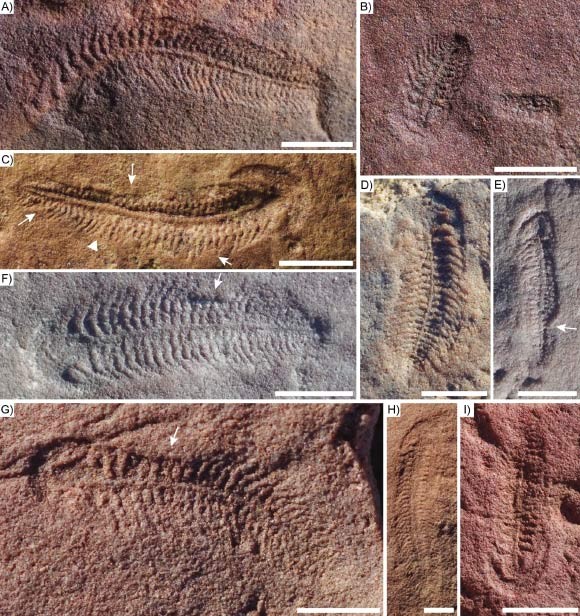
Spriggina floundersi. That’s the name. A soft-bodied creature that squirmed along the ocean floor 550 million years back. Before eyes evolved really. Before brains got big.
But apparently before the urge to favor one side of your body died out.
Researchers in South Australia found a batch of fossils. Not just one or two. Over one hundred pristine impressions. They all told the same story. A consistent bias toward one side. It suggests left-right behavior—what we call handedness—is way older than we gave credit for.
The Setup
The Ediacaran period was a strange time. 635 to 539 million years ago. Life was figuring itself out. Single cells became multicellular mobs. Some grew large enough to see without a lens. They moved. Actually moved.
The Flinders Ranges in South Australia are ground zero for this stuff. Nilpena Ediacara National park holds secrets. Specifically storm events that buried seafloor communities instantly. Snapshots frozen in stone.
Among them sits Spriggina floundersi.
It was described way back in 1958. Back then only three specimens were known. Now we know it better. It was one of the first animals with bilateral symmetry. Front, back. Left, right. Top, bottom. The same layout you and I use to walk around.
The Twist
“We talk about holding a pencil,” says Dr. Scott Evans from the American Museum of Natural history. He is also based at Florida State university. “We think of soccer kicks.”
This guy had no hands. No feet.
But he had a preference.
To find it the team measured shape variations. They looked at collections in Adelaide too. The rocks were mirror images of the living creatures. So when a fossil bent left in the stone the animal actually bent right in life.
Here is the kicker. Roughly twice as many specimens bent right as bent left.
It wasn’t random noise. It was population-wide handedness. The oldest on record.
Some of the traits we take for granted have ancient roots. We just stopped looking far back enough.
Dr. Mary Droser of UCR isn’t surprised really. It fits the pattern. Complex traits usually appear early then stick.
What It Means
Why does a flat worm-like thing care about directions?
Complex nervous systems.
If an animal favors a side it usually means it has sensors. Eyes? Lateral lines? Something. It processes the world differently on each flank.
“Insects. Octopuses. Birds.” Dr. Evans lists them. “They have handedness too.”
He suspects Spriggina wasn’t just a bag of soup. Its wiring might have been surprisingly similar to modern animals. At least structurally.
The paper came out July 9, 2016 in Scientific Reports.
It forces a rethink of the timeline. We assume simple creatures are simple inside. They aren’t always. They might have internal compasses we never knew they had.
So maybe handedness isn’t a tool-use trick. Maybe it’s just how symmetry breaks when things start to feel.