Landslides happened there.
They aren’t just dust shifts. We are talking about chunks of ice massive enough to bury entire cities if they landed here on Earth.
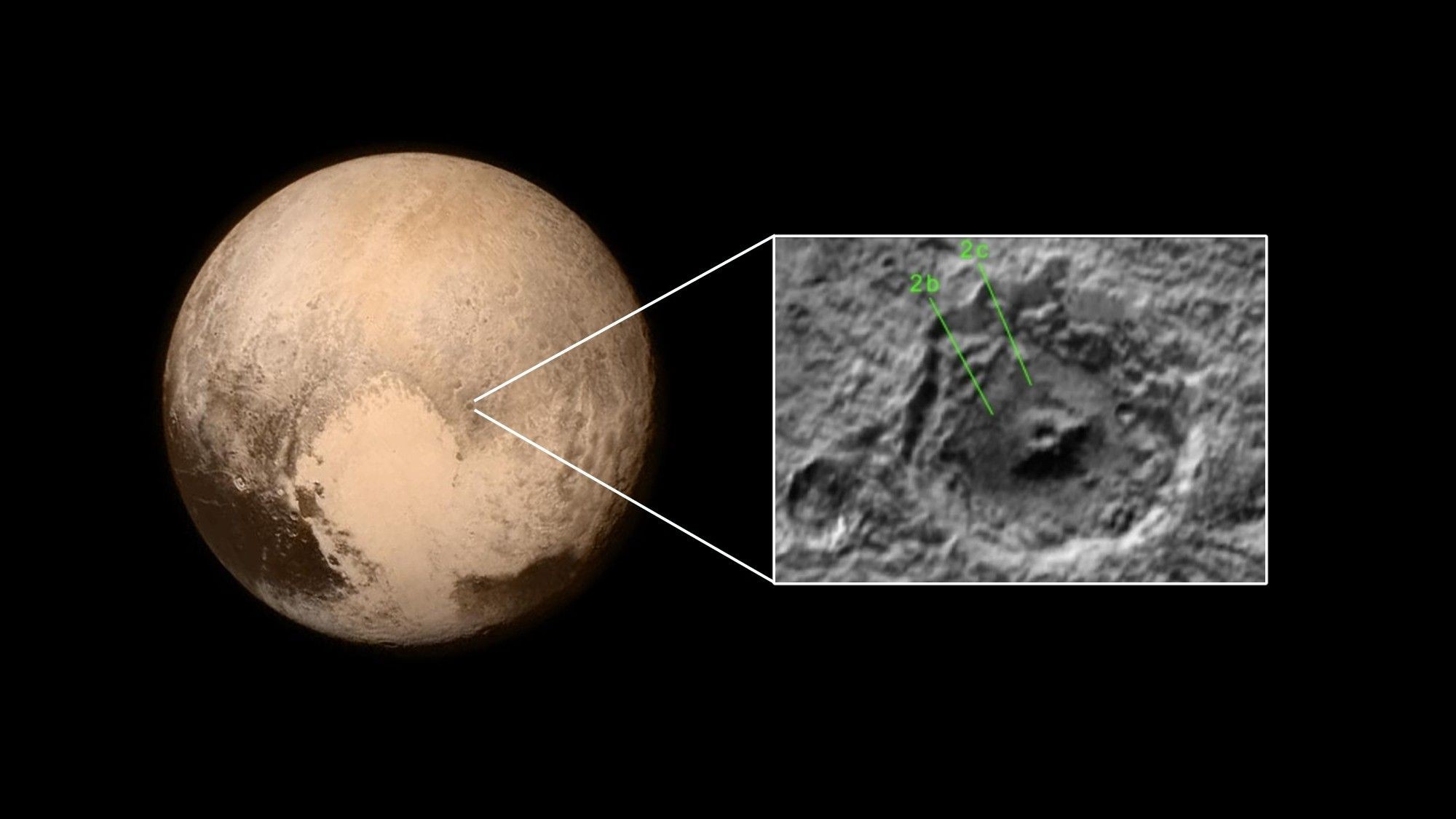
The proof sits in the archives of the New Horizons flyby back in 2015. A team led by geologist Marco Discenza went digging. They looked hard. Specifically, they pored over shots from the LORRI camera, which can spot things as small as 98 feet or about 30 meters wide. What they found? Convincing evidence for six separate landslides. All of them dumped down the inner walls of craters lining the western edge of Sputnik Planuria, that heart-shaped patch everyone recognizes when they think of the dwarf planet.
You might say, isn’t Pluto just a frozen rock?
It used to look that way. But look closer.
Before now, we’ve seen landslide scars everywhere. Mars. Ceres. The icy moons hanging around gas giants. Even Charon, Pluto’s moon buddy, shows signs of similar trouble. But Pluto itself? This is the first time.
Here is how it looks:
- One massive slide dropped 1.4 miles straight down inside the Coughlin crater. It probably happened because another impact shook up the rim nearby.
- Two more slides were found in the Giclas crater.
- Another three were spotted in a nameless crater.
The debris didn’t just sit at the bottom. It spilled out. Big debris aprons. Some stretched over nine miles or about 14.5 kilometers from the source. The material looks bumpy in spots, suggesting giant blocks of solid ice tumbled down. Where the material broke off, the cliffs remain sharp. Concave. Clean.
These are some of the most mobile landslides we’ve ever seen in the solar system.
Why? Low gravity helps. So does the ice. It doesn’t friction like rock on earth does. The biggest apron covers 50 square miles. Just to put that in perspective, that area could swallow a large town without leaving a trace.
What caused the slides?
For Coughlin, we know. An impact nearby. For the other five? We aren’t sure yet.
One idea points to thermal stress. Pluto’s orbit is elliptical. It gets a little closer to the Sun, crosses inside Neptune’s path, then swings back out. That subtle heating and cooling cycle makes volatile materials—molecular nitrogen, carbon monoxide, methane—sublimate and condense over time. That expansion and contraction stresses the ice.
It could crack it. It could make it fall.
We probably have more proof out there. The spacecraft hurried past in July 2015. It didn’t stick around. We simply don’t have the imagery to confirm every single scar. The planet kept its secrets. Maybe some still remain hidden in the shadows we didn’t bother to photograph.