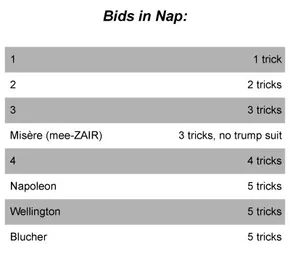
Nap, or Napoleon, is a trick-taking game that moves at a breakneck pace. It isn’t named after the inventor. It isn’t even named after the person who popularized it. It is named after one of the specific bids you can make. Two of Napoleon Bonaparte’s historical enemies, the Duke of Wellington and Gebhard von Blucher, also show up as bidding options. The game uses a standard 52-card deck, supports two to six players, and ends when the first person hits 30 points.
What happens when you bid Napoleon, Wellington, or Blucher?
These three bids are special. They all require you to take all five tricks in the hand. You cannot fail. But they rank differently and carry different scores.
The hierarchy of high bids goes from lowest to highest:
1. Napoleon
2. Wellington
3. Blucher
If you bid Napoleon (5 tricks), another player can outbid you by calling Wellington or Blucher. The risk is what separates them.
- Making the bid: If you succeed in taking all five tricks, you score 10 points.
- Failing the bid: Opponents score points against you for stopping you.
- Defeating a Napoleon bid: Opponents score 5 points.
- Defeating a Wellington bid: Opponents score 10 points.
- Defeating a Blucher bid: Opponents score 20 points.
Blucher is the biggest gamble. You win 10 points if you land it, but you hand your opponents 20 points if you miss. That is a steep price to pay for a single trick error.
How to play a standard hand
The dealer shuffles and deals five cards to each player. The deal happens in groups. You can do three then two, or two then three. Bidding starts with the player to the dealer’s left.
Each player has one option:
* Pass
* Bid a number of tricks to win (3, 4, or 5)
* Bid a special high contract (Napoleon, Wellington, Blucher)
* Bid Misère
A standard bid does not name a trump suit. You only promise a number of tricks. If everyone passes, the hand is thrown in. No score.
The highest bidder becomes the Maker. The other players team up to stop the Maker from taking the promised tricks.
Determining the trump suit
The Maker leads the first card. The suit of that card becomes trump.
There is one exception. If the bid is Misère, there is no trump suit. Misère outranks a bid of 3. It is a “no-trump” contract where you must take exactly the number of tricks you bid, but without the safety net of a trump suit.
Play proceeds clockwise. You must follow suit if you can. If you cannot follow suit, you can play a trump card or discard. The highest trump card wins the trick. If there are no trumps, the highest card in the led suit wins. The winner of the trick leads to the next one.
Scoring: Keeping the math right
Nap is a zero-sum game. Points gained by the Maker are lost by the opponents. Points lost by the Maker are gained by the opponents. Your table scores must always add up to zero.
If the Maker makes the bid:
* Standard bid (3 or 4 tricks): Score the number of tricks bid. No extra points for overtricks.
* High bid (Napoleon, Wellington, Blucher): Score 10 points.
If the Maker fails the bid:
* Standard bid: Opponents score the number of tricks bid.
* Misère: Opponents score the number of tricks bid.
* Napoleon: Opponents score 5.
* Wellington: Opponents score 10.
* Blucher: Opponents score 20.
Why play Napoleon instead of Bridge?
Bridge is slow. It is precise. It requires memorizing bids and conventions. Napoleon is a sprint. You deal, bid, play five tricks, score, and deal again. It is easy to learn the rules in two minutes. It is hard to master the timing.
The game rewards aggression. Bidding Blucher is