An artificial ‘Saturn’s ring’ is coming. Or maybe it’s already forming.
Astronomers are sounding the alarm. Not about a celestial body. About our own tech.
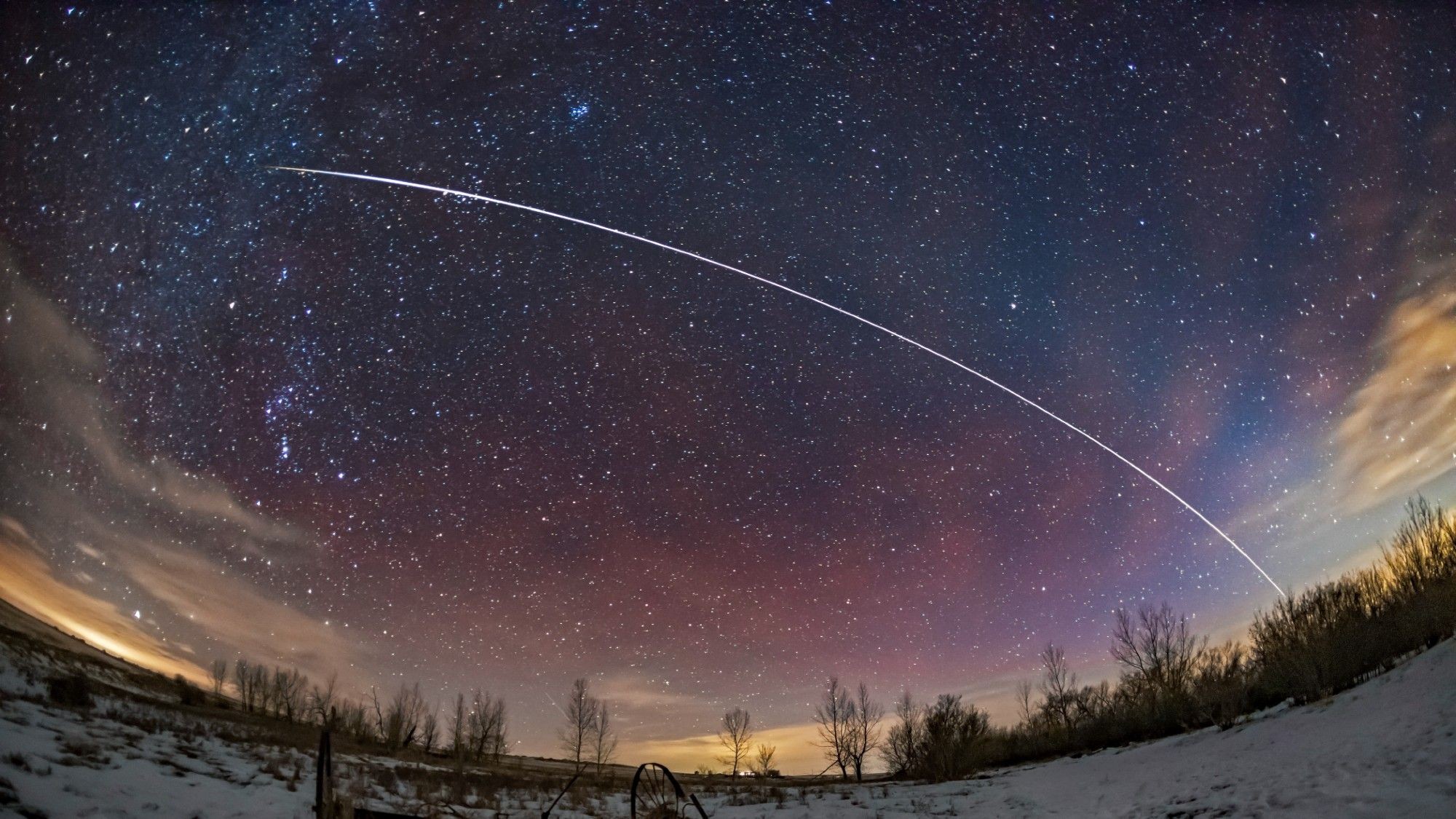
If current plans hold, the night sky could soon be dominated by a bright band of satellites. This “ring” would circle Earth after dusk and before dawn. It would outshine every star. Every planet. Maybe even the full moon.
It wouldn’t be subtle. It would be a luminous band stretching across the sky. Visible from every corner of the planet.
Hugh Lewis, a professor of astronautics in the U.K., has some stark words on the situation. He told Space.com that we are running out of room. The only way to fit all these proposed data center constellations is to stack them. One above another. Right on the terminator line—the boundary between day and night.
“The impact on the night sky would be absolute catastrophic.”
When you look up at night now, what do you see? Darkness. Maybe a few stars. If you’re lucky, the Milky Way. That’s the view that inspires awe. That view might not be ours to keep.
A few years ago, this sounded like science fiction. Not anymore. The orbital data center frenzy kicked off last year. And it’s accelerating.
Companies like SpaceX, Starcloud, Cowboy Space Orbital, and Blue Origin are moving fast. They’ve applied to the U.S. Federal CommunicationsCommission (FCC) for licenses. Together, they want to launch more than one million satellites.
China is jumping on the bandwagon too. Plans for an orbital data center network are on the table. Within five years? Maybe sooner.
But wait. There’s more.
California-based Reflect Orbital has a different goal. They want to launch 50,001 space mirrors. Not to send data. To reflect sunlight back to Earth. To power solar plants after sunset.
They got the green light from the FCC on Friday, July 10. Their first mirror, a 60-by-60-foot demonstration satellite named Eärendil- an 1, is set to launch by year-end.
Here is the problem. To get 24 hours of constant sunshine, these satellites need a specific orbit. The dawn-dusk orbit. It follows the terminator. It passes over the North and South Poles.
It’s not like Starlink. Starlink satellites are spread out. These will be bunched together. In a single plane. Moving in the same direction.
Samantha Lawler, an astronomat the University of Regina, agrees. She and her team used computer models to visualize these fleets. SpaceX’s Starmind. Blue Origin’s Project Sunrise. Cowboy Space’s Stampede.
The results are sobering.
In their models, these satellites don’t just outshine stars. They outnumber them. As Earth rotates under this terminator orbit, the ring moves across the sky. Twice a day. Around 6 to 8 p.m. And again, just before dawn.
“[The ring] would pass overhead at the_same time every night.”
Lawler notes that this effect is worse in winter. The sky stays darker for longer. The ring becomes a permanent fixture.
Is this accurate? The models rely on public data. The work hasn’t been peer-reviewed yet. But Lawler isn’t convinced they need more data to know this is bad news.
Even when the ring dips below the horizon, the sky doesn’t go dark. Scattered light continues to brighten the atmosphere for up to two hours. Like sunset, but persistent.
“We could do a lot less science for same cost,” Lawler said. “Many science cases, including the search for near-Earth asteroids, would be seriously compromised.”
Taxpayer-funded telescope time? Less effective. Wasted.
There’s no escape. This affects the whole world.
And it might not just be a ring. Some constellations, like Project Sunrise, plan to use multiple orbital inclinations. Near the equator? You’d see an “X” shape of crawling satellites. Further north? Two separate bands. One in the morning. One in the evening.
How bright will it be? Hard to say exactly. Depends on the number.
But here’s the kicker. Reflect Orbital’s mirrors will be at least as bright as Venus. Venus is the brightest object in the sky, after the moon. Imagine 50,00 of them. In a line.
An earlier study by the European Southern Office estimated that 50,00 mirrors would increase night sky brightness by 300 percent. Effectively blinding our most expensive telescopes.
John Barentine, an astronomer and dark sky advocate, puts it plainly. Humanity has already turned Earth into an artificial “ringed planet.” Choked by debris. Satellites.
Now, projects like Reflect Orbital want to turn those invisible rings into bright tracks.
“We aren’t talking about just scattered field of bright, moving dots any more.”
“This is a permanent, artificial ‘ring effect cutting right through critical twilight windows.”
On paper, the business logic is sound.
Earth-based data centers are expensive. They need water. Cooling. Land. They strain grids. They emit greenhouse gases. In space? Sunlight is free. Cooling is easier. Power is abundant.
Reflect Orbital argues they can help. Sunlight after dark could boost solar yield. Provide sustainable lighting for construction. Illuminate disaster zones for search and rescue. They claim to minimize astronomical disruption. To cooperate with scientists.
“Every stage of our development is guided by testing, measuring, listening and adapting,” a spokesperson said.
Astronomers say it doesn’t work that way.
“If we have mirrors in orbit, astronomy over,” Lawler said.
The American Astronomical Society (AS) issued a statement. They criticized the FCC for approving Reflect Orbital’s test satellite.
“Potential for significant harm,” they wrote. To members. To anyone dependent on a dark sky.
Harm could include:
– Damage to sensitive telescope equipment.
– Flash-blinding pilots and drivers.
– Permanent eye damage for anyone looking through a mid-sized telescope.
Recall Starlink? Astronomers praised SpaceX’s early efforts. Dark paint. Visors. Dimming the reflectivity.
But Lawler points out the counter-move. SpaceX made the satellites bigger. Much bigger.
First-generation Starlinks weighed about 570 pounds. Latest generation? 4,400 pounds each.
“They did a lot of work to make satellites darker, but then they made them bigger and put them lower. That made them much, much brighter.”
You can see them. Naked eye. Every night. All over the sky.
So what stops this?
The FCC’s order stated that optical astronomy impacts “fall outside” their review. Their rules don’t cover sky protection. They declined to address the concerns.
It’s a regulatory vacuum.
Astronomers point out that no other U.S. or international body reviews satellite licenses for environmental or astronomical impact. The FCC is the only game in town for US launches.
“The FCC is the only agency regulating American satellite launches,” Lawler said. “But if the FCC says this isn’t their problem, then whose problem is it?”
The AAS called on the FCC to consider all impacts. Not just spectrum. Not just collisions.
“In the absence of another licensing agency… we believe that it is critical for FCC to consider all the impacts,” the society wrote.
Robert Massey, executive director of the U.K. royal Astronautical Society, called the FCC’s decision “disappointing.” And dangerous.
It sets a precedent. It opens the floodgates. For 50,00 satellites. In just a few years.
We wanted to reach for the stars. But we’re building a cage of light.
And we’re locking the door from the outside.