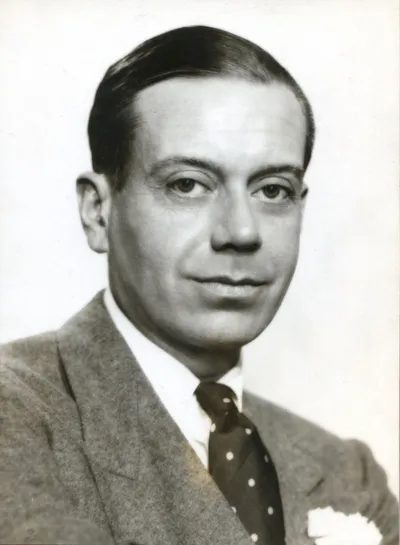
Cole Porter didn’t just write songs; he curated an attitude. Born in Peru, Indiana, in 1891, he carried a level of worldly élan into American music that matched the urbanity of his own life. He was the grandson of a millionaire speculator, and that moderate affluence likely smoothed out the rough edges of his style, leaving behind a poise that defined his work.
By age six, he was already handling a violin. Piano came at eight. Ten-year-old Porter composed operettas in the style of Gilbert and Sullivan. A waltz he wrote was published when he was just eleven. It was a fast start.
At Yale, he didn’t just study. He churned out about 300 songs. You might know tracks like “Eli,” “Bulldog,” or “Bingo Eli Yale.” He wrote college shows. He also played the part of the serious academic, studying at Harvard Law School in 1914 before moving to the Graduate School of Arts and Sciences for music the following year.
His Broadway debut in 1916 with See America First was a flop. The show closed after just 15 performances. That didn’t stop him.
When the U.S. entered World War I in 1917, Porter went to France. He wasn’t in the military service, despite later rumors to the contrary. Instead, he became an itinerant playboy in Europe. He lived openly as a homosexual, yet he married Linda Lee Thomas, a wealthy older American divorcée, on December 18, 1919. They spent the next two decades traveling and partying, sometimes together, sometimes apart. It was a life lived on its own terms.
Everything changed in 1928. Porter wrote several songs for the Broadway hit Paris. That success triggered a golden run of musical comedies. The list reads like a who’s who of 20th-century pop culture:
- Fifty Million Frenchmen (1929)
- Gay Divorcée (1932)
- Anything Goes (1934)
- Red, Hot and Blue (1934)
- Jubilee (1935)
- Dubarry Was a Lady (1939)
- Panama Hattie (1940)
- Kiss Me, Kate (1948)
- Can-Can (1953)
- Silk Stockings (1955)
He worked on motion pictures concurrently with these stage hits.
The songs themselves are what stick. “Night and Day.” “I Get a Kick Out of You.” “Begin the Beguine.” “I’ve Got You Under My Skin.” “In the Still of the Night.” “Just One of Those Things.” “Love for Sale.” “My Heart Belongs to Daddy.” “Too Darn Hot.” “It’s Delovely.” “I Concentrate on You.” “Always True to You in My Fashion.” “I Love Paris.”
Porter was especially good at the catalog song. The best-known examples are “Let’s Do It” and “You’re the Top.”
His work continues to stand as the epitome of sophisticated, civilized detachment in the popular song form.
He was one of the wittiest lyricists of all time. His mastery of the interior rhyme was subtle but powerful. That style became his signature. It was a detached, civilized take on popular music that rarely got its hands dirty.
The output might have been even larger if not for a horse-riding accident in 1937. The injury left him a semi-invalid. He required 30 operations. Eventually, one of his legs had to be amputated. Yet he kept writing. The sophistication remained, even when the man behind it was in constant pain.
What does that say about the separation between the artist and the art? The songs feel effortless. The life was complicated. The music stays.