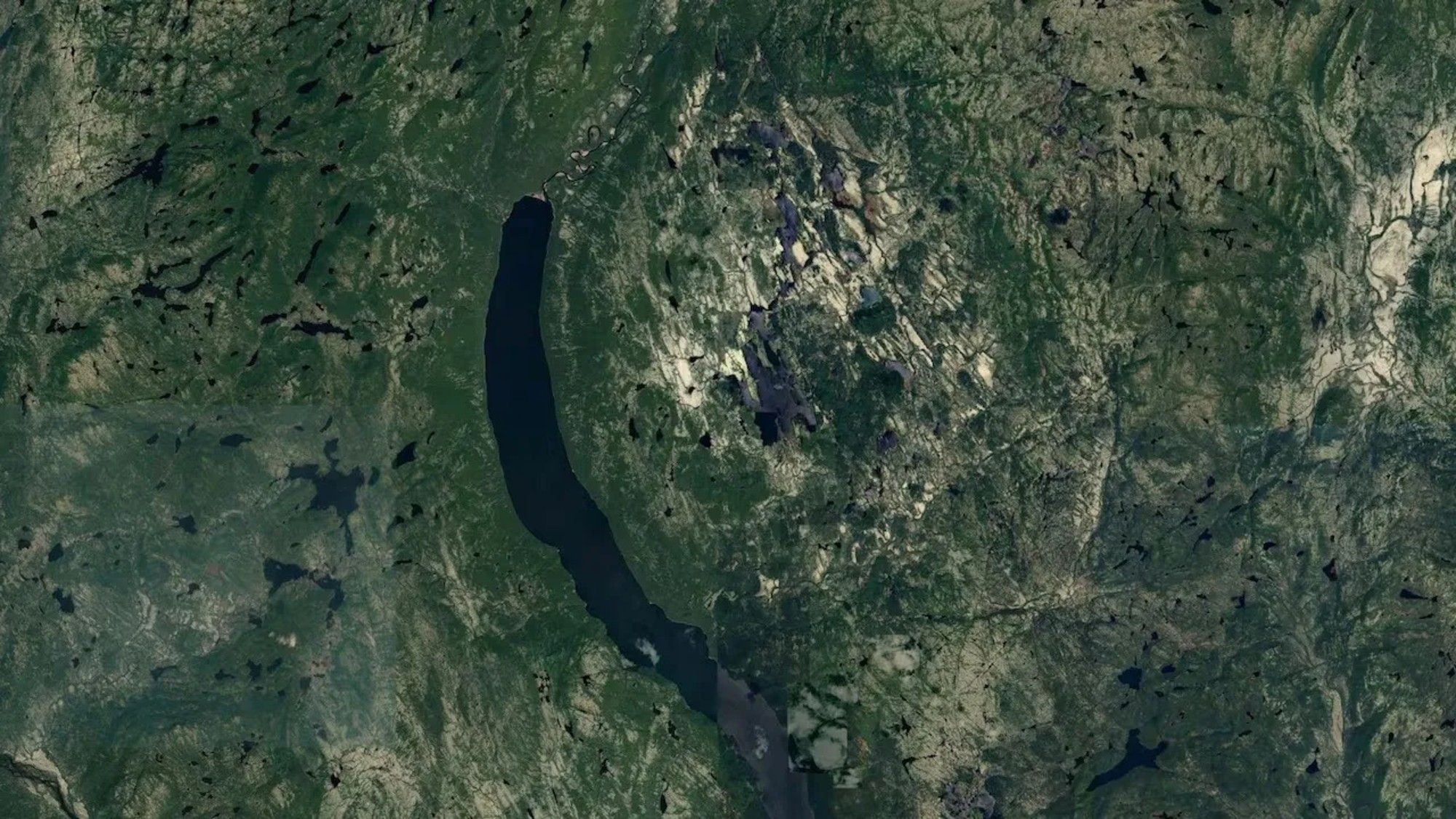
Joël Lapointe was just trying to plan a camping trip. It was two years ago, back in the prep phase for a 2024 vacation in Quebec’s Côte-Nord region. He wasn’t hunting for geological mysteries. He was staring at Google Maps, plotting a route near Lake Marsal, when the terrain looked… wrong.
The topography didn’t match the surrounding landscape. It looked like a scar.
Lapointe, an amateur astronomer, had a hunch. Could this be an impact crater? He didn’t just leave it at that. He submitted a report to Impact Earth, a crowdsourced database managed by Western University’s Planetary Sciences and Exploration Institute. The goal? To track potential impact sites worldwide.
His hunch turned out to be right.
In 2025, Gordon Osinski, a planetary geologist at Western University known affectionately as “Oz” by those in the field, led an expedition to the site. What he found shocked him. Not just because it was an impact crater. But because of how massive it was.
The feature, now officially named Uhackatik (with the blessing of the Innu Council of Ekuanitshat, whose traditional lands it occupies), is roughly 15 miles (24 kilometers) wide. It’s approximately 390 million years old. And according to Osinski, it might be the biggest impact crater discovered on land in recent years.
Why This Discovery Matters for Lunar Exploration
Most craters from the Devonian period don’t survive long. Erosion. Tectonic shifts. They get buried or ground down. Finding a pristine example of one from 390 million years ago is like striking geological gold.
But there’s another reason this discovery is getting attention beyond the academic journals: it helps us understand the Moon.
Osinski points to the Kamestastin crater (also known as Mistastin Lake) in northern Labrador. It’s roughly the same size as Uhackatik. It’s well-preserved. And crucially, it shares a key mineral trait with the lunar surface: anorthosite.
NASA is using Kamestastin to train astronauts for the Artemis program. The agency wants to land humans near the Moon’s south pole. That region is rich in anorthosite. By studying Kamestastin, they can test rovers and gear in an Earth environment that mimics lunar conditions.
“Kamestastin is actually a great [comparative crater] as the size is very similar,” Osinski told Space.com. “Kamestastin is well-p preserved and I’ve worked there a lot … so in my mind, I was using it as a template for exploring this new potential impact crater.”
In fact, Artemis II astronauts Jeremy Hansen and Christina Koch, along with CSA backup astronaut Jenni Gibbons, visited Kamestastin in 2023. They went with Osinski. To walk on a crater like this is to walk on a stand-in for the lunar surface. Uhackatik offers a new, older, and similarly sized analogue for future deep-space planning.
Shocked Rock and Shatter Cones
How do you know a crater is from a meteor and not a volcano? Volcanoes melt rock. Meteorites shatter it.
During the field survey, Osinski’s team looked for specific signs. They found them.
“Impact melt rocks are like they sound: large volumes of rock that are melted bythe impact event, but then cool and crystalize to look a lot like volcanic rock,” Osinski explained. “Finding these preserved … was a big surprise.” Usually, the melt is the first thing to erode away. It’s fragile. Its presence here suggests the crater is exceptionally well-preserved beneath the surface layer.
On a larger scale, they spotted “shatter cones.” These are branching, conical fracture patterns in rock layers. They form only under the extreme pressure of a hypervelocity impact. You don’t get them from earthquakes. You don’t get them from volcanoes.
The evidence is definitive.
How Uhackatik Compares to Other Major Impacts
For years, the Hiawatha structure in Greenland held the title of the most recently discovered massive crater. It was spotted in 2018. It’s about 31 kilometers wide.
But Hiawatha is buried under ice. Its origin and exact diameter are still debated by some scientists. Is it an impact feature? Maybe. But you can’t walk on it. You can’t easily take samples.
Uhackatik is different.
“It’s not buried,” Osinski noted. The shock metamorphic effects are visible. The scale is confirmed. At nearly 25 kilometers across, it dwarfs most other terrestrial impact structures.
To put that in perspective, Tycho Crater on the Moon is a famous, well-preserved impact site. Osinski notes that Uhackatik likely looked like Tycho did hundreds of millions of years ago. Before the Earth’s atmosphere and water wore it down.
This discovery fills a gap. We have small craters. We have ancient, eroded basins. We have buried giants like Hiawatha. But we rarely find a large, accessible, clearly identified impact structure from the Devonian period that allows for direct surface analysis.
What Happens Next
The research hasn’t gone through peer review yet. But the findings are ready for scrutiny.
Osinski plans to present the data at the 88th Annual Meeting2 of the Meteoritical Society in Frankfurt this August. The scientific community will weigh in. They will look at the samples. They will check the dating.
If confirmed, Uhackatik joins an elite club of impact features. It reshapes our understanding of the frequency of large impacts in the last 400 million years. And it gives NASA a new, Earth-based playground to prepare for missions to the Moon and Mars.
For now, the crater sits quiet in Quebec’s north. A silent scar from a violent past. Waiting for the next question. Who else is looking?
Is it possible that more such features are hiding in plain sight? Google Earth is full of them. Most people scroll past. They’re looking for a house. A road. A destination.
They aren’t looking at the scars left behind by the universe.