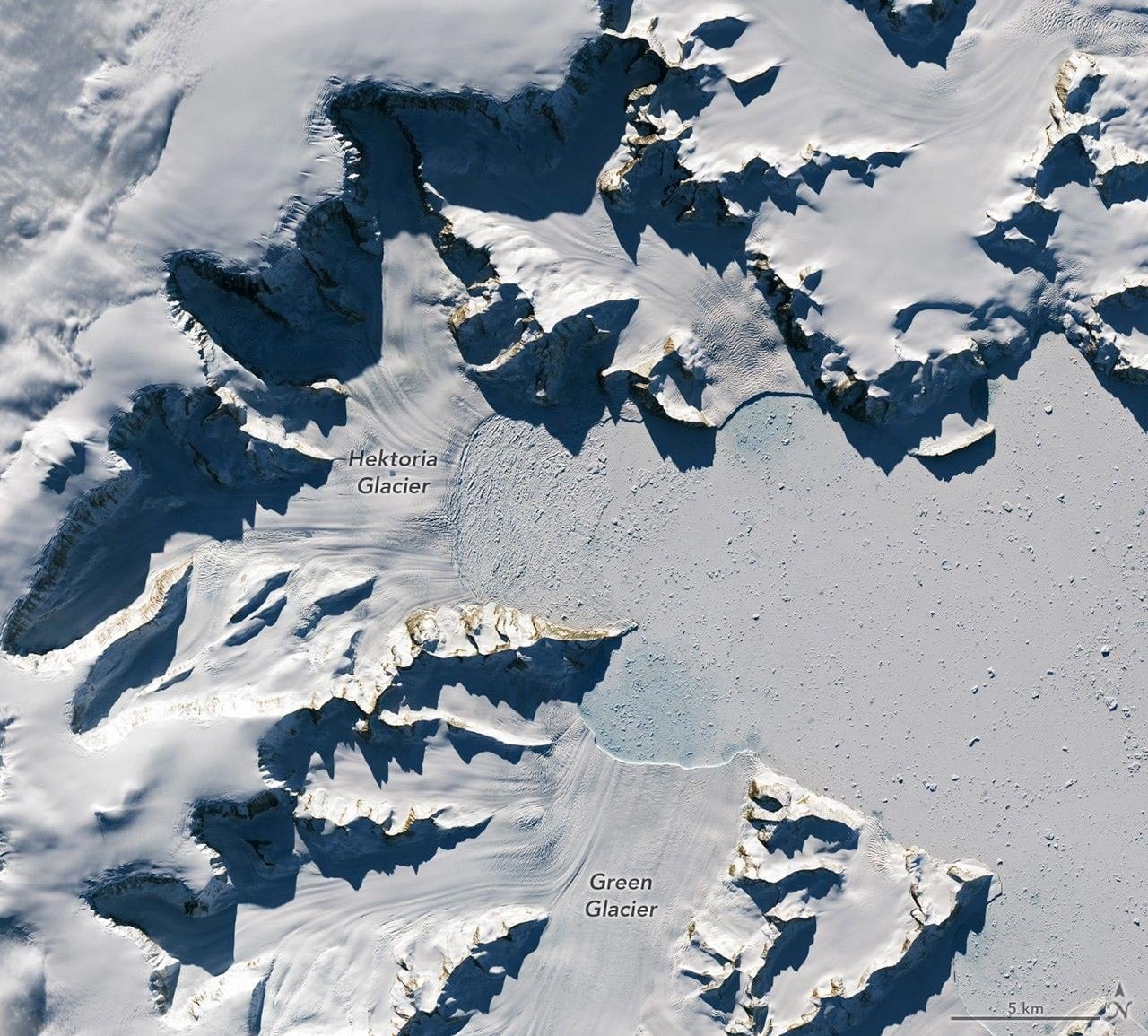
Hektoria Glacier just broke a record no one wanted it to break. In two months it lost more ice than some glaciers lose in centuries. Scientists were stunned. And a bit terrified.
Between January 2022 and early March 2023 this patch of Antarctic ice retreated 25 kilometers. That’s roughly 15 miles of pure disappearance. During the wildest two-month stretch alone the edge pulled back 8 kilometers. 5 miles in six weeks. It is the fastest collapse of grounded ice anyone has ever recorded.
Built to Fail?
Here’s why it happened.
Hektoria sits on the Antarctic Peninsula. Like many neighbors it starts on land then flows into the sea forming a thick floating shelf called an ice tongue. But Hektoria had a flaw in its foundation. It sat on a flat patch of seabed. Flat is dangerous. It lets the ice sit precariously close to the ocean.
When the sea ice around it finally broke up that flat grounding zone became a trap. The glacier didn’t just slide forward. It broke apart. And not gently. It dumped a huge chunk of grounded ice into the water. That stuff turns to water eventually. Which raises sea levels. Directly.
Is this the new normal? Probably.
The Calm Before the Break
You have to look back 20 years to understand the fragility.
In 2002 Larsen B ice shelf—think of it as a massive concrete dam made of ice—collapsed overnight. Before Larsen B Hektoria was held in place by it. After Larsen B the support was gone. Glaciers in the area started thinning. They started retreating. The process was slow for a decade. Then it stopped.
Why? Because landfast sea ice froze around the front in 2011. This hard shell acted like a buttress. It propped Hektoria up. The glacier even advanced a little. It felt safe. It was not safe. It was waiting.
January 2022 brought powerful ocean swells. Those swells smashed the protective sea ice shell. The buttress vanished. Instantly.
By summer the floating ice tongue was gone. Shattered by calving. The glacier retreated 16 kilometers before winter even arrived. It looked like it might stop. The winter freeze usually acts as a pause button.
It wasn’t.
NASA’s ICESat-2 lasers watched the ice keep thinning through the dark months. The surface was calm but underneath the glacier was bleeding.
The Ocean’s Lever
So why the sudden second surge of destruction in the spring?
Earthquakes under the ice gave away the secret. The ice wasn’t sliding on a slope. It was lying flat. An ice plain.
At high tide seawater slides underneath the thinning ice. Buoyancy takes over. The water lifts the glacier slightly off the rock. When the tide goes out gravity pulls it down. This lifting action stresses the ice until it snaps. Scientists call it buoyancy-driven calving.
It sounds gentle. It is violent. Large plates of ice detach and break apart all at once because the water lifted them right out from under the glacier. Hektoria lost another 8 kilometers this way. It’s not a slow melt. It’s a structural failure.
Better Eyes on the Ice
Naomi Ochwat from the University of Innsbruck isn’t just looking at Hektoria. She’s worried about all of them.
As the Peninsula warms more glaciers are losing their ice tongues. They become tidewater glaciers ending directly in the ocean. That makes them unstable. That makes them dangerous.
Good news. We are getting better eyes.
NASA and its partners are launching new tools. The NISAR satellite uses radar to track surface movement with centimeter precision. Ted Scambos from the University of Colorado thinks the data will be huge for structural checks. Then there’s SWOT. Originally designed for water it might also watch the cryosphere. Sea ice. Shelves. It’s about finding the weaknesses before the ice gives up.
A Fjord in Waiting
Hektoria is likely slowing down.
Scambos isn’t surprised. The glacier has lost too much height. Too much mass. Physics takes over eventually. It literally cannot move as much ice as it used to. It is starving.
“It’s on its way to being a fford not a glacier.”
That is a strange way to say a landscape is dead. But it fits. Hektoria won’t disappear forever but it won’t be what it was either. Just water where ice used to be.